Functional communication
Request. Refuse. Choose. Ask for help. Get attention. Repair a misunderstood message.
The Autism Skills Handbook · 6 essential skill domains
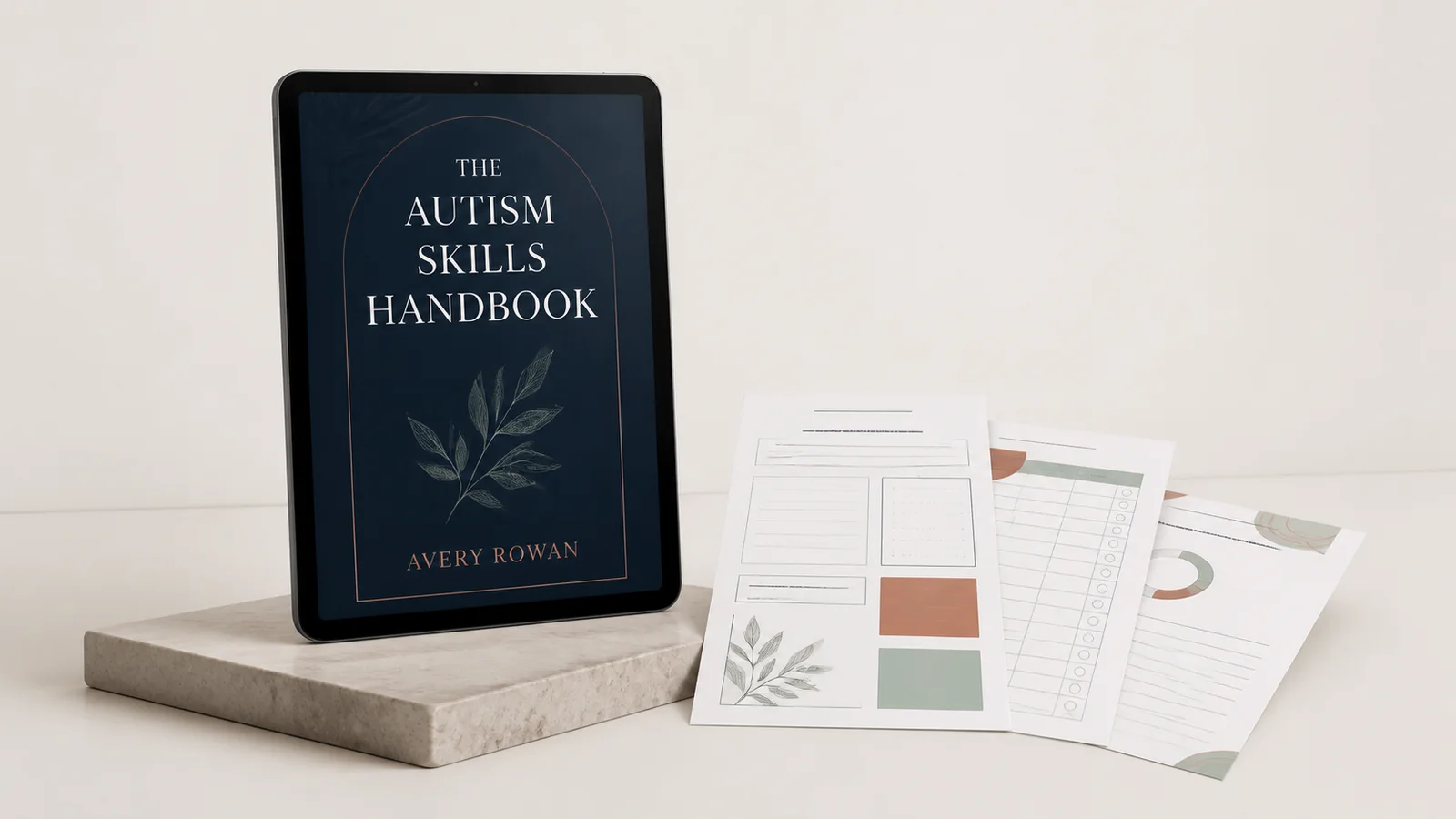
300+ pages. Dozens of real-life skills. One clear system for autistic children, teens, and adults.
What you build
Not abstract theory. Specific skills that improve communication, learning, participation, daily life, and independence.
Request. Refuse. Choose. Ask for help. Get attention. Repair a misunderstood message.
Use speech, signs, gestures, pictures, or AAC. Understand directions. Build useful phrases and flexible language.
Engage. Share attention. Imitate. Follow useful cues. Learn with less adult prompting.
Join play. Wait. Take turns. Handle groups. Participate at home, at school, and in the community.
Move through transitions. Follow routines. Practice dressing, hygiene, meals, home tasks, and self-care.
Make choices. Advocate for needs. Use supports. Build safety, flexibility, and long-term independence.
Prove it to yourself
Four real excerpts. Nine planning tools. No vague preview—the sample opens after you submit the form.
Already convinced? Get the book
Inside the handbook
Compare possible goals by daily-life impact and by how many other skills they support.
Put one skill into an existing routine and choose a simple way to track it.
Review provider clarity, supervision, use outside sessions, and progress.

Across the lifespan
Start with the skills that matter now. Keep the long-term path visible.
Build functional communication, engagement, imitation, play, routines, and school readiness.
Strengthen self-advocacy, flexible routines, group participation, daily living, and growing independence.
Use the same system for communication, decision-making, daily life, support quality, and long-term independence.
22 chapters
The chapter order moves from choosing priorities and learning foundations into communication, daily routines, school, and independence.
Understand everyday development, compare goals, and decide what deserves attention first.
Work through motivation, engagement, shared attention, imitation, and prompting.
Cover functional communication, AAC, receptive language, naming, phrases, and flexible language.
Address play, transitions, routines, school readiness, group learning, home practice, and independence.
18 appendices
Appendices include goal-planning worksheets, an AAC starter map, a prompt-fading tracker, a home-practice planner, a school-readiness checklist, team-alignment tools, and service-review questions.
The complete handbook
Stop searching. Stop stitching together disconnected advice. Get all 22 chapters and all 18 appendices in one digital handbook.
Questions
The purchase includes one 308-page digital PDF with 22 core chapters and 18 appendices, planners, checklists, and decision tools. Gumroad handles checkout and digital delivery.
It supports planning across the lifespan: autistic children, teens, and adults. The handbook is written for parents, caregivers, educators, therapists, and other support-team members who need a clearer sequence for building practical skills.
Yes. The free sample includes excerpts from the Introduction and Chapters 1, 10, and 21, plus nine downloadable planning tools.
No. The Autism Skills Handbook is a digital PDF delivered through Gumroad after checkout.
No. It is an educational resource and does not replace diagnosis, medical care, therapy supervision, or school-based legal advice.