
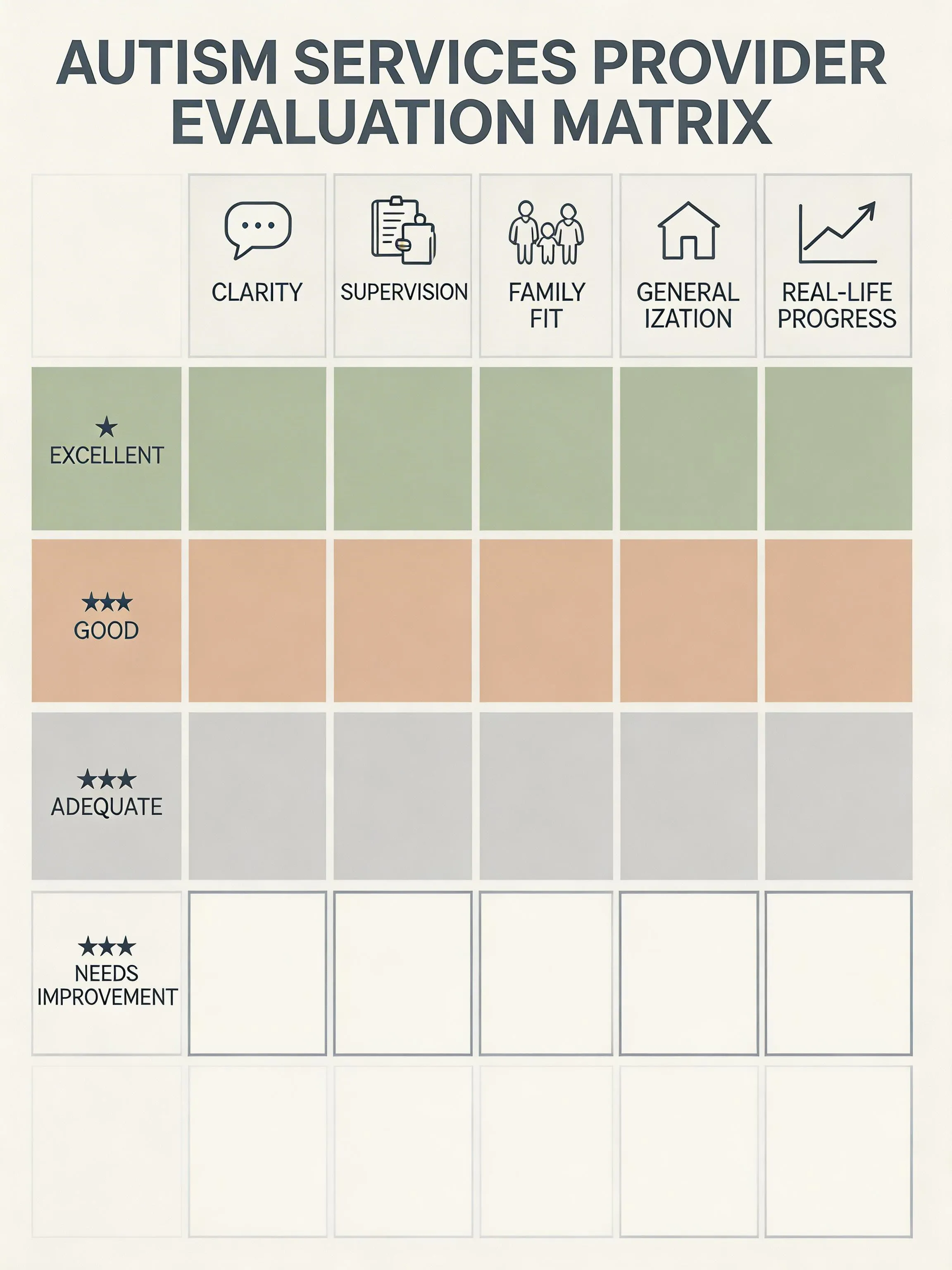
Many families are told to “build a team” as if more adults automatically means better support.
It does not.
A larger team can still produce more confusion if no one agrees on priorities, teaching logic, or what progress should look like in daily life.
A good team is aligned, not just crowded
The child does not benefit when one adult pushes speech drills, another pushes compliance, another pushes sensory language, and everyone measures success differently.
A better team can answer the same core questions:
- What matters most right now?
- What is the missing skill under the current struggle?
- What does success look like in real routines?
- What should adults do consistently across settings?
If the adults cannot answer those questions the same way, the child often ends up carrying the cost.
Parents are not passive observers
One of the clearest markers of weak service quality is when parents are treated as spectators who should simply trust the process.
Parents do not need to know every technical term. But they should be able to understand:
- why a target matters
- how it connects to daily life
- what the plan is
- how progress is being judged
- what they should and should not try at home
If a service model cannot be explained clearly, the problem may not be the parent.
More hours are not always better support
Families often assume quality can be measured by intensity alone.
But a high-hour program can still be weak if:
- goals are poorly chosen
- prompts never fade
- carryover is unrealistic
- adults chase appearance over function
- the child becomes more managed than more independent
Quality is not just effort. Quality is the relationship between goals, teaching, fit, and generalization.
Questions worth asking a team
Useful questions include:
- What is the highest-leverage target right now?
- How does this goal change daily life?
- What does independence look like here?
- How do you avoid building prompt dependence?
- What should home carryover actually be?
These questions quickly reveal whether a team is thinking clearly or selling confidence.
Watch what happens outside the session
A service should not only create isolated performance.
Look for whether the child is becoming:
- easier to understand
- more able to ask for help
- more able to handle transitions
- less dependent on adult cueing
- more able to participate across settings
Those are harder outcomes to fake.
Read next
If the deeper issue is goal confusion, read How to Choose Autism Goals That Matter.
If you want the complete framework for aligning home, school, and therapy work, start with the book.