
One of the most expensive mistakes in autism support is not poor effort. It is poor prioritization.
Families and professionals often inherit a pile of possible goals:
- speech
- behavior
- play
- school readiness
- social skills
- routines
- academics
- independence
The problem is that a long goal list is not the same thing as a smart sequence.
The harder a family is working, the more expensive poor prioritization becomes. A weak goal does not only waste time in therapy. It also consumes:
- family energy
- home-practice time
- teacher bandwidth
- emotional hope
That is why goal choice matters so much more than it first appears.
A good goal changes more than one thing
The strongest goals do not only improve one narrow performance. They create leverage.
A high-leverage goal often does at least one of these:
- reduces a major daily-life bottleneck
- unlocks other learning opportunities
- makes communication more useful
- reduces dependence on adult rescue
- travels across routines and settings
That is why “learn ten picture labels” is often weaker than “ask for help,” “wait briefly,” or “tolerate a transition with support.” The first may look academic. The second changes daily life.
Ask what makes life harder than it needs to be
Before writing goals, identify the live friction points.
Examples:
- the child cannot get help without crying
- transitions trigger repeated distress
- group instruction falls apart immediately
- the child waits for adult cues instead of initiating
- routines only work with constant prompting
Those problems often point toward better goals than generic lists do.
That is the first major filter. Good goals usually sit close to live friction, not far from it.
Use three filters before you commit to a goal
1. Is it functional?
Will this skill matter outside a teaching moment?
2. Is it foundational?
Will this make later skills easier to teach?
3. Is it teachable now?
Is the child close enough to the target that progress is realistic without overload?
If a goal fails all three filters, it is probably attractive but badly timed.
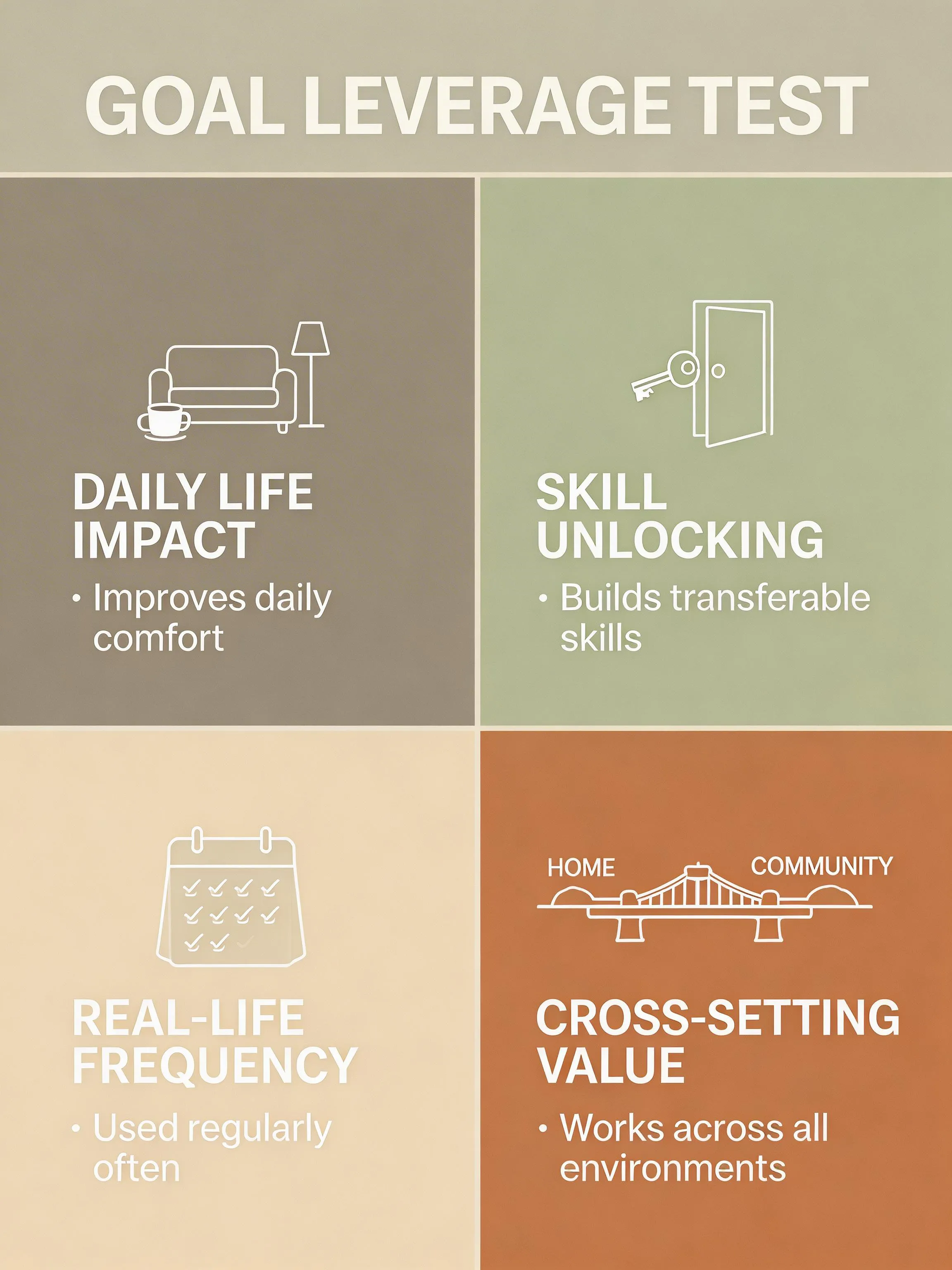
You can also make the test even simpler by asking:
- Will this make daily life easier now?
- Will this unlock more learning later?
- Can we practice it often in real routines?
- Will it matter with more than one person or in more than one setting?
That is the spirit behind the high-leverage worksheet.
Common examples of high-leverage goals
Depending on the child, strong early or mid-stage goals often include:
- functional requests and refusals
- shared attention and initiation
- imitation
- prompt fading and independent starts
- transition tolerance
- group participation
- everyday independence steps
These are not glamorous goals. That is part of why they get skipped. But they often change more than people expect.
Common examples of weakly timed goals
Weak goals are not always wrong forever. They are often wrong now.
Examples include:
- long label lists with little real-life use
- advanced sentence forms before functional communication is reliable
- table tasks before shared attention is solid
- school academics before group learning is workable
- goals that require constant adult cueing to look successful
That last category matters a lot. A crowded plan can look productive while actually teaching prompt dependence instead of independence. If that sounds familiar, read Prompt Dependence in Autistic Children.
Common examples of weakly chosen goals
Weak goals are not always useless. They are often just poorly timed.
Examples include:
- long label lists with little real-life use
- advanced language forms before functional communication is reliable
- school tasks before group readiness exists
- surface compliance goals that increase adult control but not independence
A child can look “busy” while the real bottleneck stays untouched.
Good planning sounds like this
Better teams ask:
- What is the missing skill under the problem?
- What goal would make the biggest difference this month?
- What can be practiced in real routines, not only in therapy?
- What will matter across home, school, and community life?
That is the difference between a large plan and a useful one.
How many goals are realistic at once?
Families and teams often ask for the perfect number. There is no fixed answer, but there is a practical rule:
If the plan is so large that nobody can carry it into ordinary life, it is too large.
A smaller plan is often better when:
- the child is early in support
- the adults are already stretched
- generalization is weak
- progress data is noisy
Two or three strong, well-supported goals often outperform a sprawling plan of ten weak ones.
Re-check the plan every month
A goal can be strong in March and weak in June.
That is because leverage changes as the child changes. Once a bottleneck improves, the next best target may shift.
Useful review questions include:
- Which goal changed daily life the most this month?
- Which goal still depends on too much adult support?
- Which goal has not generalized at all?
- Which new bottleneck is now visible because another one improved?
That kind of review keeps the plan alive instead of static.
Read next
If your team struggles to stay aligned around priorities, read How to Build a Good Autism Support Team.
If school pressure is making academics feel urgent, read Autism School Readiness Checklist.
If you want the full book-level system for prioritizing goals across development, it lives in The Autism Skills Handbook.
For a comprehensive framework for therapy and IEP goals, see How to Set Autism Therapy Goals That Actually Work.