Most children receiving autism support have too many goals, and the wrong ones are often prioritized. The result is a plan that looks comprehensive on paper but produces scattered effort and slow progress in practice.
This guide covers how to choose goals that actually change daily life, what the leverage test is, and how to avoid the most common goal-setting mistakes.
Why most goal lists do not work
A typical therapy plan or IEP might list 10-15 goals across communication, behavior, academics, social skills, self-help, and motor development. Each goal sounds reasonable in isolation. But nobody — not the therapist, not the teacher, not the parent — can meaningfully work on 15 goals simultaneously.
What happens in practice is that a few goals get active attention, some get occasional practice, and many sit on the plan untouched until the next review. Progress reports may show “some progress” across the board, but the daily reality is that nothing has fundamentally changed.
The problem is not effort. It is selection.
The cost of too many goals:
- Adult attention is split across too many targets, so no single goal gets enough practice density to produce real change.
- The child experiences constant shifting between demands, which reduces engagement and increases prompt dependence.
- Progress on any single goal is slow, which makes it hard to tell whether the approach is working or the goal is wrong.
- Families feel overwhelmed because “working on goals at home” means trying to remember a dozen different targets during an already exhausting day.
The leverage test
Not all goals are created equal. Some goals, when achieved, change the child’s daily life dramatically. Others look impressive on paper but make almost no practical difference.
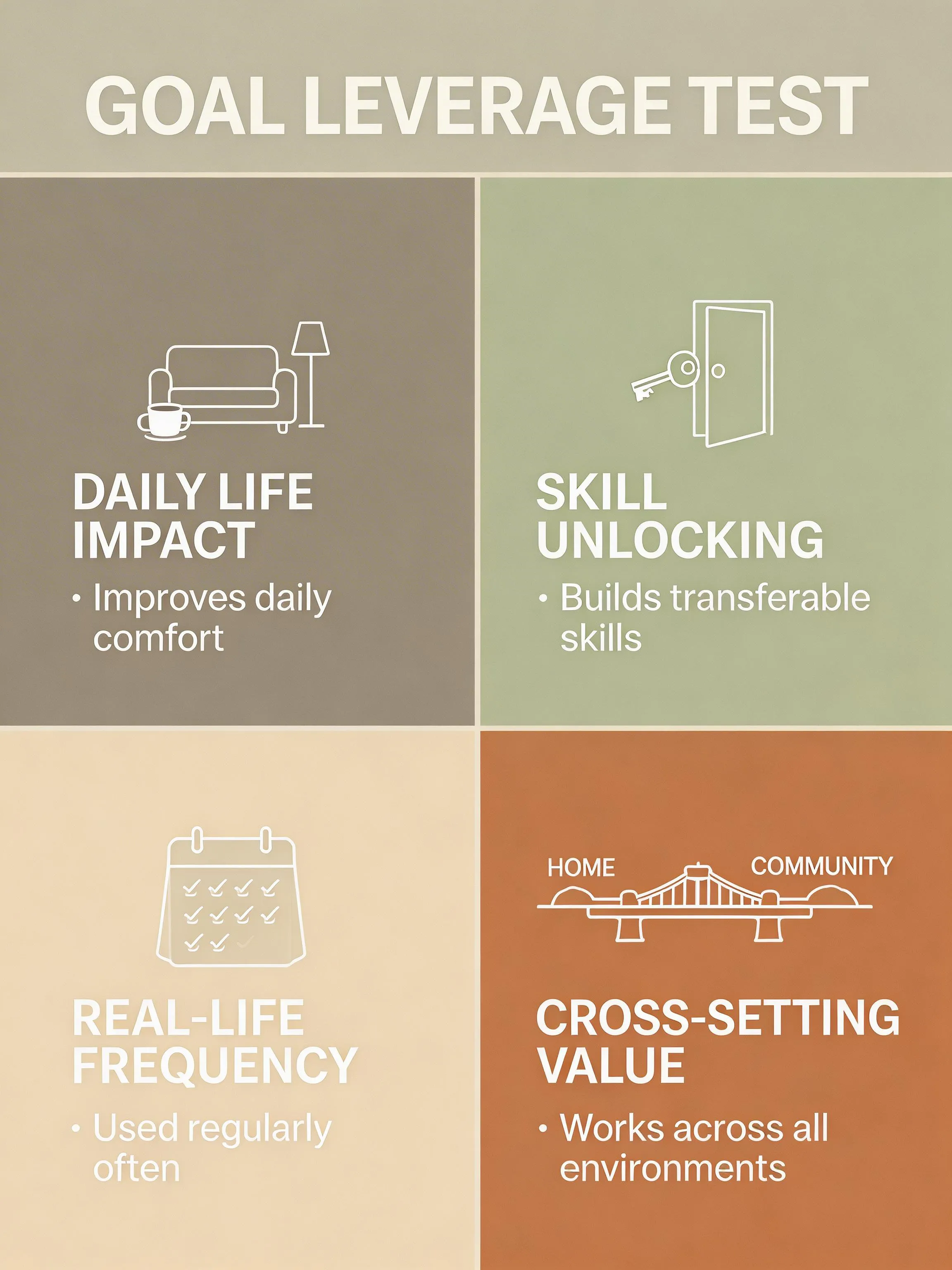
The leverage test asks one question: If this goal were achieved, what else would change?
High-leverage goals create cascading effects. When a child learns to ask for help, meltdowns during challenging tasks decrease, adult-child interactions become more positive, and the child begins to attempt harder things because they know rescue is available. One skill, many ripple effects.
Low-leverage goals produce isolated improvements. A child who learns to identify colors can pass that test, but nothing else in daily life changes as a result. The skill sits alone, unconnected to the problems that actually cause friction.
Examples of the leverage test in action:
| Goal | Leverage | Why |
|---|---|---|
| ”Ask for help” using any modality | High | Reduces meltdowns, increases task persistence, improves adult-child relationship |
| ”Identify 20 sight words” | Low | Academic skill with no daily life impact until much later |
| ”Tolerate transitions with a visual schedule” | High | Reduces conflict at every transition point throughout the day |
| ”Stack 10 blocks” | Low | Fine motor practice that does not transfer to meaningful contexts |
| ”Refuse appropriately” (instead of hitting/crying) | High | Reduces behavioral escalation, preserves social relationships |
| ”Name 50 body parts” | Low | Labels without functional value in daily communication |
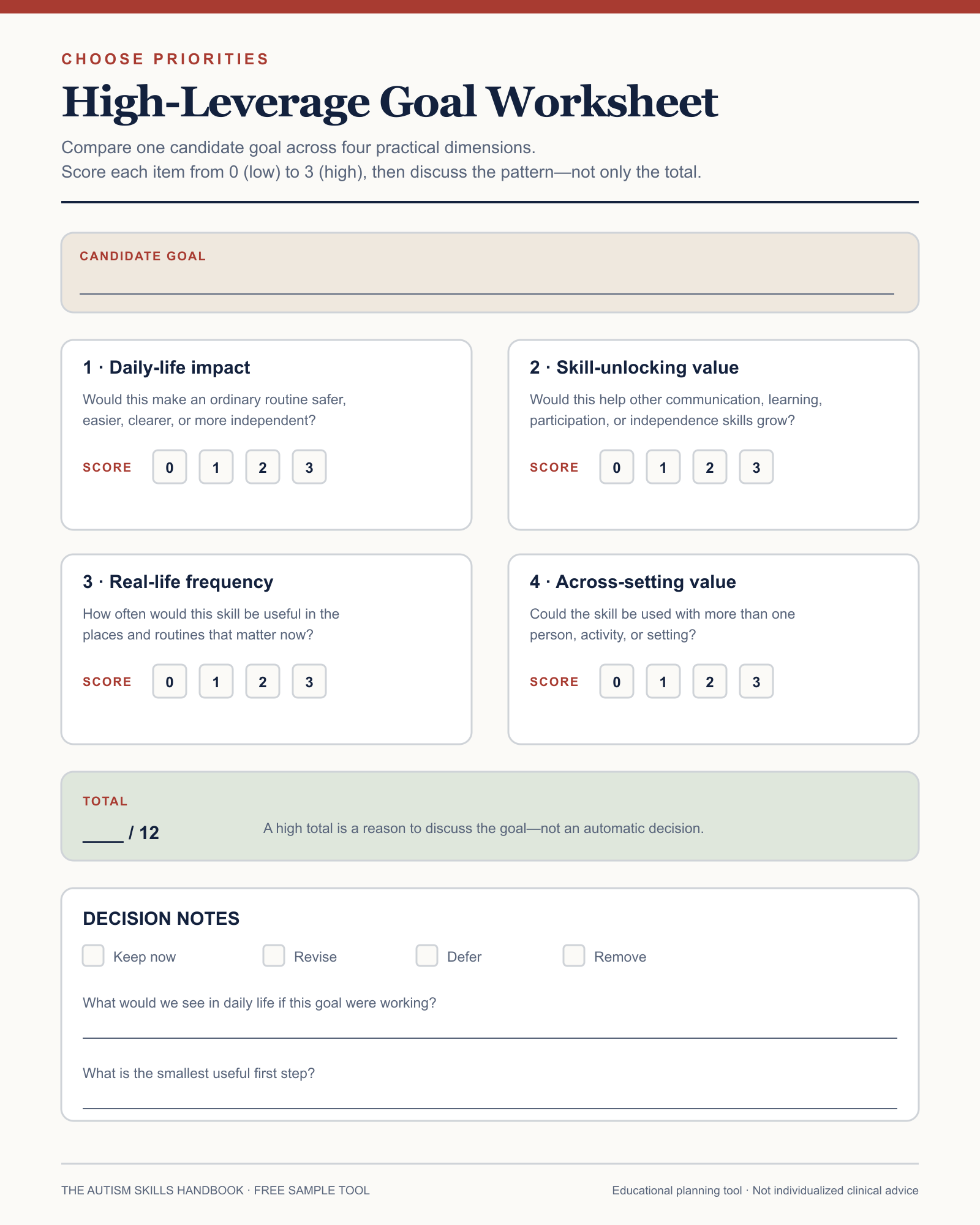
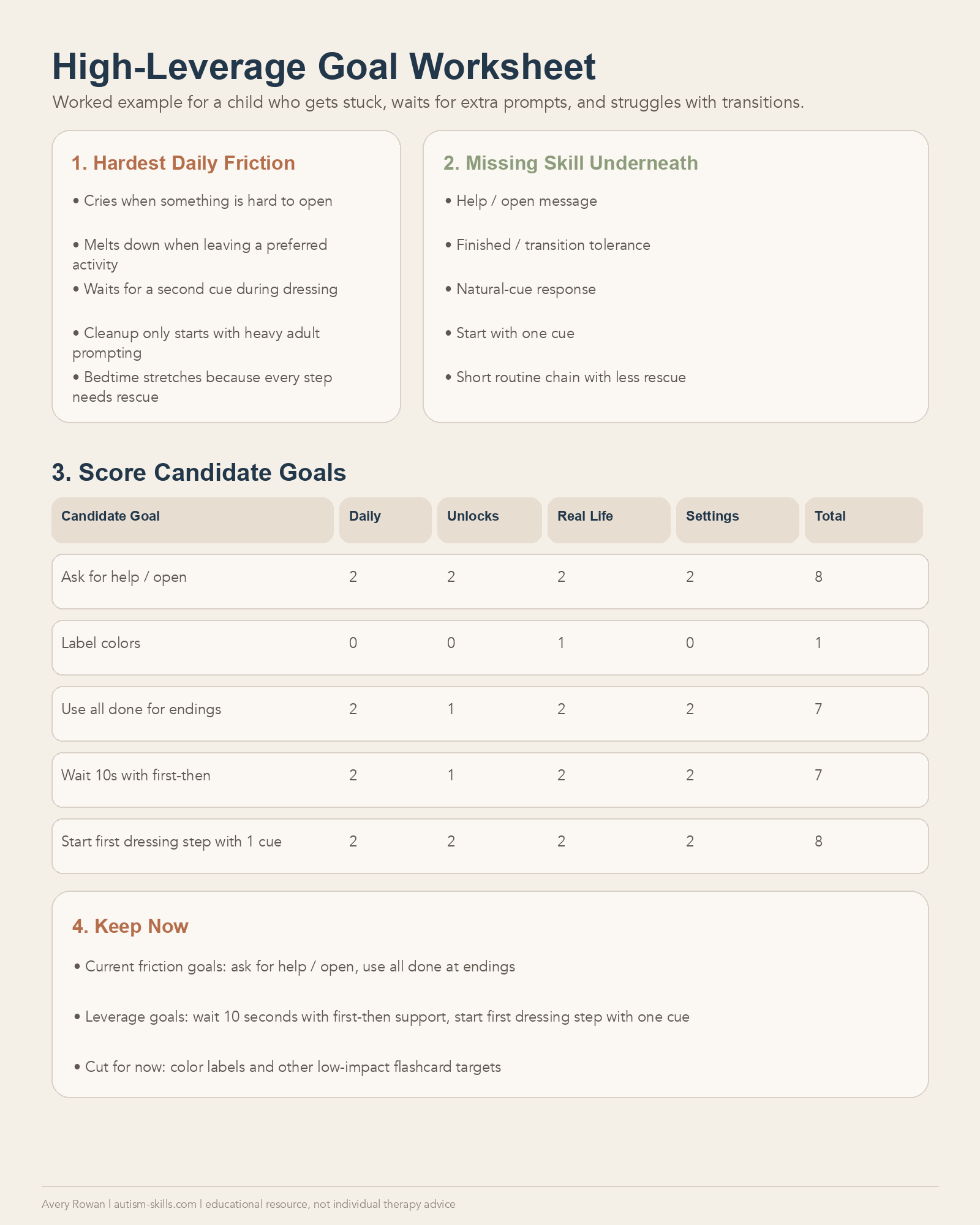
The handbook’s High-Leverage Goal Worksheet provides a structured scoring tool for comparing candidate goals and deciding what to keep, cut, or defer. The Goal Leverage Worked Example shows exactly how the scoring works with real goals.
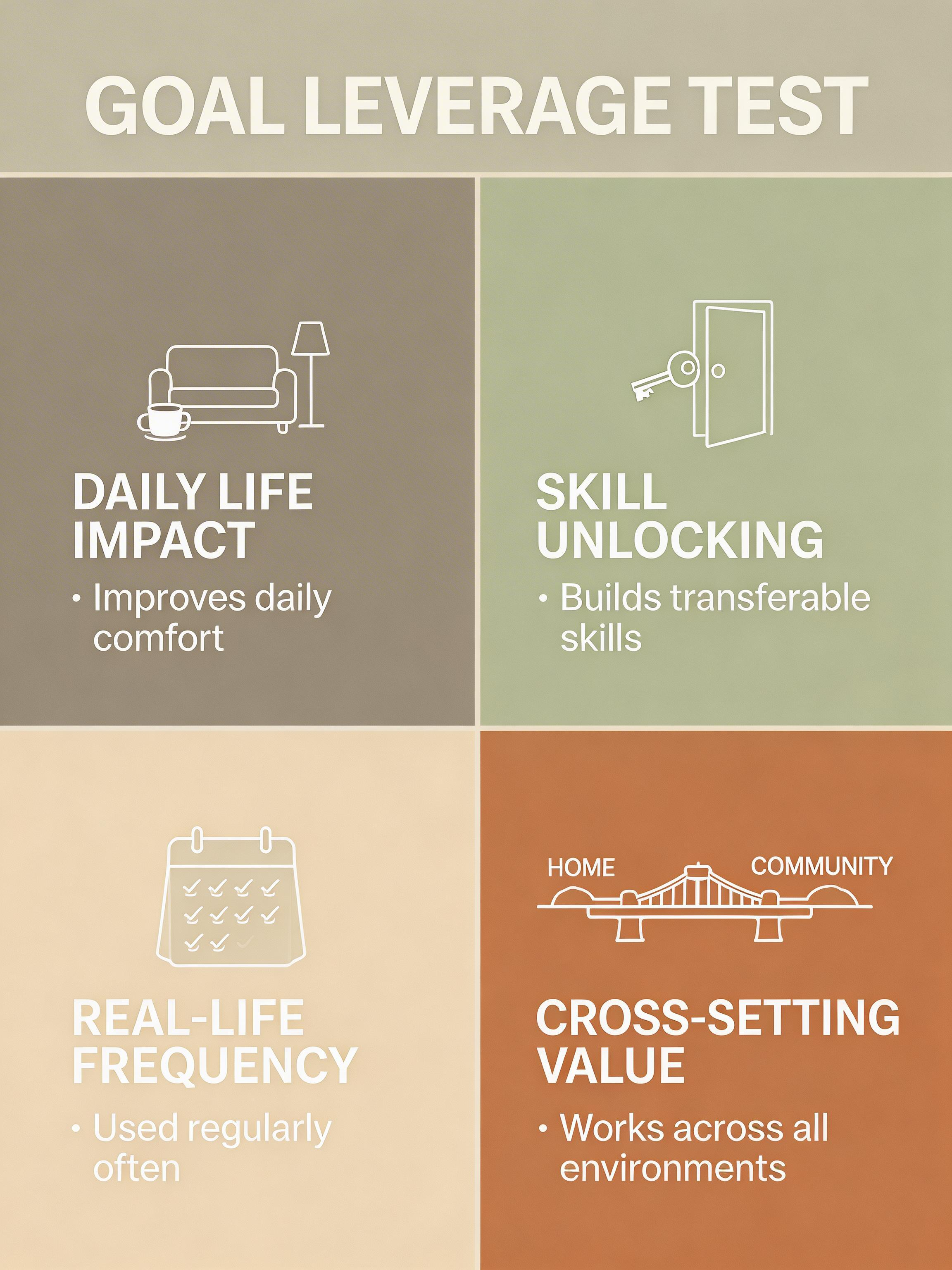
For a deeper dive into this logic, read How to Choose Autism Goals That Matter.
Writing goals that survive daily life
A well-chosen goal can still fail if it is written in a way that only works during structured therapy sessions. Goals need to be designed for real life from the start.
Make goals observable and contextual
Instead of: “Improve communication skills” Write: “Request a preferred item using sign, picture, or word in at least 3 different daily routines (meals, play, getting dressed)”
The second version tells everyone — parents, teachers, therapists — exactly what to look for and where to look for it. It cannot be fudged in progress reports because either the skill is happening in daily routines or it is not.
Build in generalization from day one
If a goal can only be demonstrated at the therapy table with one specific set of materials and one specific adult, it is not yet a real skill — it is a therapy performance. Goals should specify multiple contexts, materials, and people from the beginning.
Include a maintenance criterion
Goals that require constant adult support are not goals for independence — they are goals for compliance. A well-written goal includes criteria for the child performing the skill with reduced support over time, not just with full prompting forever.
When to cut or replace a goal
One of the hardest decisions in goal planning is knowing when a goal is not working and needs to be replaced. Parents and professionals often hold onto goals too long because they have already invested time in them.
Signs a goal should be cut or redesigned:
- No meaningful progress after 6-8 weeks of active work. Not slow progress — no progress. The approach needs to change, or the goal is wrong.
- Progress only shows up in structured sessions. If the child can do the skill with a therapist but not at home, school, or in the community, the goal needs a generalization redesign.
- The goal requires maximum prompting every time. If the child is not becoming more independent with the skill, the teaching approach may be building prompt dependence instead of competence.
- The goal no longer addresses the biggest daily friction. Priorities shift as children grow. A goal that was high-leverage six months ago may be less important now.
Cutting a goal is not failure. It is good planning. The time freed up can be redirected to something that will produce actual change.
How the handbook organizes goal planning
Chapter 3 of the Autism Skills Handbook introduces the full goal-selection framework, including the leverage test, priority sequencing, and common traps that lead to overcrowded plans. Chapter 9 covers prompt dependence — what it is, how it builds, and how to design goals that create independence instead of reliance on adult support.
The High-Leverage Goal Worksheet is a free download you can use immediately to evaluate your child’s current goals against the leverage criteria described in this guide.