
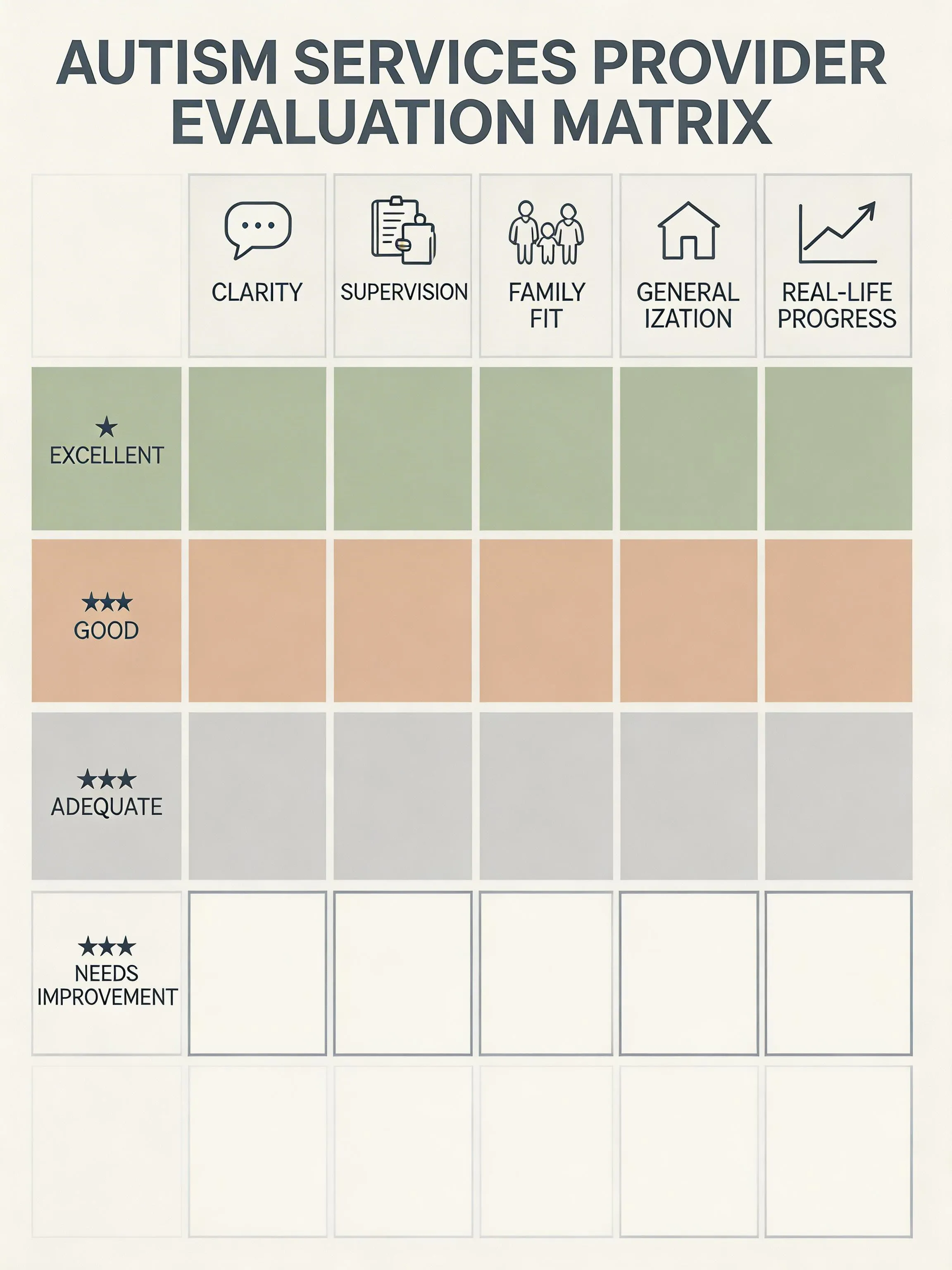
When progress stalls or anxiety rises, the default instinct is to buy more hours. More therapy. More specialists. More programs. The logic feels obvious: more input should mean more output.
Sometimes it does. But often it does not.
The difference is not about intensity being wrong. It is about intensity without clarity being expensive and sometimes counterproductive.
Why more hours feels like the right answer
Adding hours solves the emotional problem before it solves the developmental one. When a family is scared, doing more feels like doing something. Reducing hours feels like giving up.
Providers sometimes reinforce this because their business model depends on it. More hours means more revenue. That does not make them dishonest — many genuinely believe more is better. But it does create a structural incentive to recommend intensity before explaining what that intensity is built on.
The result: families pay for motion and assume motion equals direction.
What more hours actually requires
More hours only help when the plan inside those hours is good. That means:
- goals are well-chosen for this specific child
- staff are trained and supervised
- the program is reviewed and updated regularly
- what happens in therapy connects to what happens at home and school
- the child is not just compliant but actually learning
If those conditions are met, more hours can accelerate progress. If they are not, more hours just means more of the same — which may mean more of whatever is not working.
Eight questions to ask any provider
Before adding hours or starting a new service, ask:
-
Who works with my child every day, and how are they trained? The person in the room matters more than the company name. If staff are undertrained or rotating constantly, hours do not compound.
-
Who designs the plan, and how often do they observe it in action? A plan written by a supervisor who never watches sessions is a plan running on faith, not feedback.
-
How did you assess my child before starting? If the program started without a clear assessment of where the child is now, the goals may not fit.
-
How do you match the program to my child specifically? If the answer sounds like a template — same goals, same sequence, same approach for every child — the fit may be weak.
-
How often are sessions observed, data reviewed, and goals updated? Good programs have regular review cycles. If nobody can name the last time the plan changed, the plan is probably stale.
-
What would make you decide the current plan is not working? A team that has never thought about failure criteria is a team that will not catch drift.
-
What do you expect from parents, and how do you adjust when family capacity changes? A program that demands constant home follow-through without adjusting to family reality will produce guilt, not progress.
-
How will skills show up outside the therapy room? If the team cannot explain how a child’s session gains will appear at home, at school, or in the community, generalization is probably not built into the plan.
Red flags
Some patterns suggest hours are being sold before clarity is being built:
- The provider pushes intensity before explaining what the hours will contain
- Goals sound generic or copied from another child’s plan
- Progress is described in emotional terms but not in concrete, observable terms
- Nobody can explain why these specific targets were chosen
- The supervisor has too many cases to observe any of them regularly
- Parents are blamed for slow progress instead of coached
- The child is treated as a behavior problem to manage rather than a learner to understand
- Asking hard questions is met with defensiveness rather than clarity
What good intensity looks like
Good intensity is not just more hours. It is more well-designed hours with coherent goals, trained staff, regular supervision, and built-in review.
Signs it is working:
- the child’s daily life is changing, not just their session performance
- skills appear at home and school, not only in the therapy room
- the team can name the top priorities and explain why they were chosen
- parents feel informed and included, not overwhelmed and guilty
- the plan changes when the child changes
- the team actively discusses what is not working, not just what is
Before you add hours
Before paying for more, ask whether the current hours are fully optimized. Questions:
- Are the current goals the right ones?
- Is the team aligned on priorities?
- Are skills generalizing to real life?
- Is supervision actually happening?
- Does the plan get reviewed on a schedule?
If any of those answers are no, adding hours to an unoptimized plan just buys more of the same gap. Fix the plan first. Then decide if more time would help.
When more hours genuinely help
More hours can help when:
- the program is well-designed but the child needs more repetition
- the family’s schedule creates long gaps between sessions that disrupt momentum
- the child is at a stage where intensive, consistent teaching accelerates development
- the additional hours add a missing piece (like school support or home coaching) rather than duplicating what already exists
In those cases, the hours are bought with clarity about what they are for, not as a general remedy for fear.
Read next
If you want help evaluating whether your child’s current team is strong, read How to Build a Good Autism Support Team.
If the team needs better shared priorities, read Why a Team Meeting Without One Shared Plan Usually Fails.
For the full service quality framework and long-term planning guide, see the book.