
The most common communication advice parents receive is some version of “wait and see” or “talk to them more.” Neither is wrong, exactly. But neither addresses the actual problem most families face: the child is not using communication to change what happens around them.
This guide covers what functional communication means in practice, which strategies actually work at home, when to consider AAC, and how to measure whether things are improving.
Why most communication advice misses the point
Most advice about autism and communication focuses on speech — specifically, getting children to say more words. This seems reasonable until you look at what actually changes daily life.
A child who can label 100 objects in a picture book but cannot tell you they are hungry, ask you to stop, or get your attention when they need help does not have a communication system. They have a naming skill. The gap between those two things is where most frustration lives.
Functional communication means communication that does something. It changes the environment. It gets needs met. It reduces friction. When communication works functionally, the child learns that signaling matters — that their actions influence what happens next.
When communication does not change outcomes, children stop trying. They learn that nothing they do reliably produces a result, and they develop other strategies — pulling, crying, escalating, or withdrawing — that are less efficient but more immediately effective.
The single most important shift for parents is moving from “How many words does my child have?” to “What can my child accomplish with communication right now?”
Functional communication in practice
Functional communication is organized around what the child needs to do, not what it looks like. The earliest functional messages are:
- Request. “I want that.” (reaching, pointing, signing, picture exchange, spoken word — any modality counts)
- Reject or refuse. “No” or “stop” or “I don’t want that.” This is one of the most important early messages because it reduces the need for behavioral escalation.
- Get attention. “Look at this” or “Come here” or “I need you.”
- Ask for help. “Help me” — possibly the highest-leverage single message for reducing daily frustration.
- Comment or share. “Look at that” — less urgent than the others but critical for social development.
A child who can reliably request, refuse, get attention, and ask for help using any modality has a functional communication foundation. A child who can say 200 words but cannot do these four things has a vocabulary without a communication system.
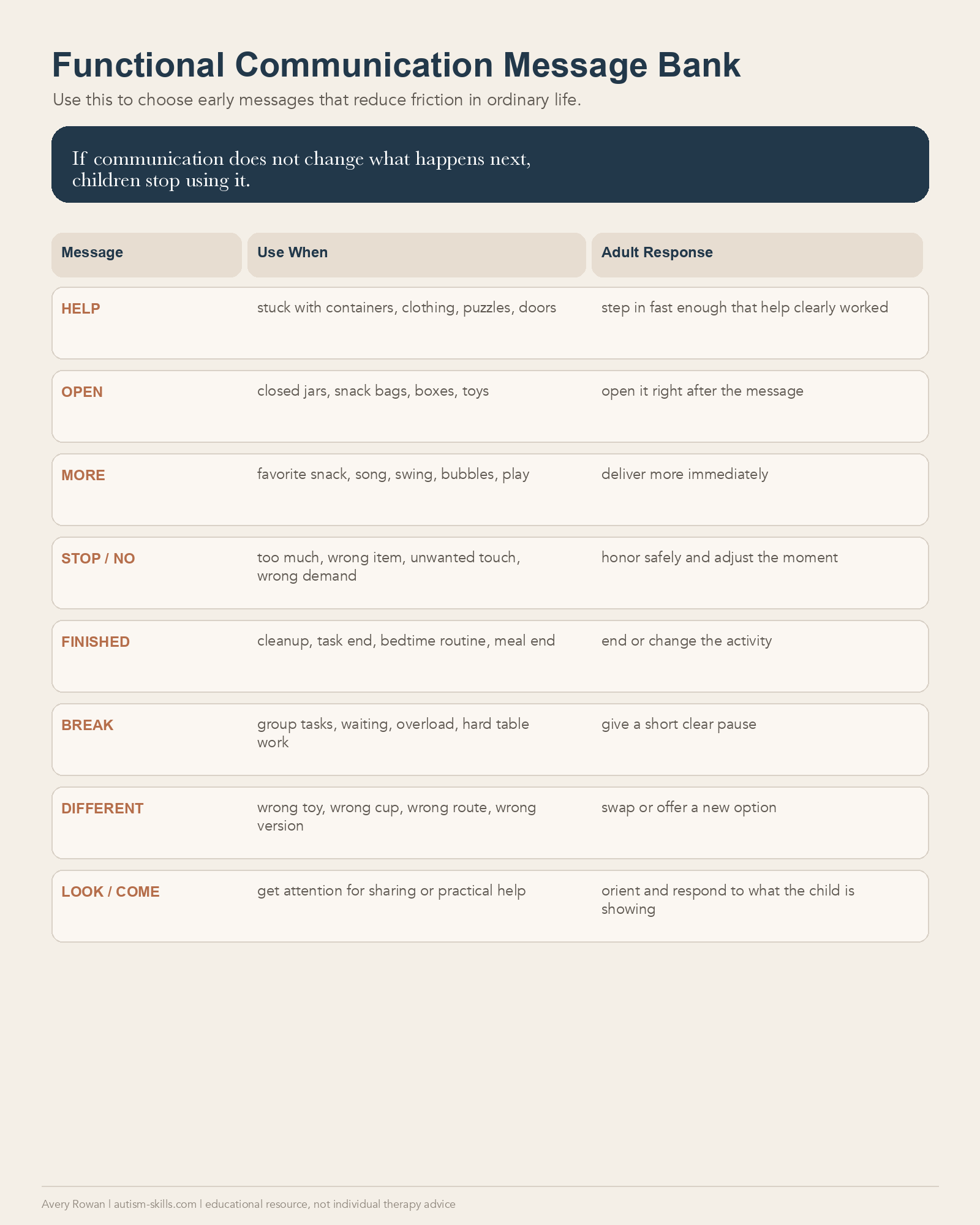
For a ready-to-use list of early functional messages with situations and adult responses, download the free Functional Communication Message Bank.
Strategies that work at home
You do not need to be a therapist to support communication development. But you do need to be strategic about how you create opportunities and respond to attempts.
Create natural communication opportunities
The goal is not to quiz your child or turn every moment into a lesson. It is to create brief, natural situations where communication is useful.
- Pause before giving. Instead of handing over a snack or toy immediately, hold it in view and wait a beat. Give the child a reason to signal — a look, a reach, a sound, a word.
- Offer choices. Hold up two items and let the child indicate a preference. This works even before words, using eye gaze or reaching.
- Sabotage routines gently. Give a bowl but no spoon. Start a favorite song and stop in the middle. Put a desired toy in a clear container the child cannot open. These create natural reasons to communicate.
- Put desired items in sight but out of reach. Not to frustrate, but to create a moment where the child needs your help — and therefore needs to signal to you.
Respond consistently to all communication attempts
This is the part most parents underestimate. If your child points, reaches, vocalizes, signs, or looks at you with intent, and something happens as a result — that is a successful communication exchange. The child learns: my signal worked.
If the child signals and nothing changes, they learn the opposite.
Consistency matters more than sophistication. A child who reliably points and gets a response is building stronger communication foundations than a child who sometimes says a word but is inconsistently responded to.
Model language at the child’s level
Match or slightly exceed your child’s current communication level. If the child uses single words, model two-word combinations. If the child uses gestures, model gestures plus a word. If the child is pre-verbal, model the communicative function — “You want the ball” while handing it over — rather than demanding imitation.
The goal of modeling is not to get the child to repeat you. It is to show them what communication looks like at the next level while keeping current communication successful.
When to consider AAC
AAC — Augmentative and Alternative Communication — refers to any communication method that supplements or replaces speech. This includes low-tech options like picture cards, communication boards, and sign language, as well as high-tech options like speech-generating devices and tablet-based apps.
The most damaging myth about AAC is that it should be a last resort — something you try only after speech has “failed.” This is backwards.
AAC does not prevent speech. The research on this is clear and consistent. Children who use AAC while speech is developing tend to develop more spoken language, not less. AAC gives children a way to communicate functionally right now, which builds the social and cognitive foundations that speech develops on top of.
The real question is not “Is my child ready for AAC?” but “Does my child need a way to communicate that is more reliable than what they currently have?”
If the answer is yes, AAC should be on the table — regardless of age, regardless of whether speech is also being targeted.
For a deeper look at the evidence and common misconceptions, read Does AAC Stop Speech? and AAC Readiness Is Usually the Wrong Question.
Moving from requests to richer language
Once basic functional communication is in place, the next challenge is expanding what the child can do with communication. This does not mean drilling vocabulary. It means gradually increasing the range of functions and contexts.
Common next steps after basic requesting:
- Commenting. “Look at that” or “I see a dog” — communication that shares experience rather than getting needs met. This is harder to teach because the motivation is social rather than tangible.
- Asking questions. “Where is it?” or “What’s that?” — requires understanding that other people have information you do not.
- Describing. “Big truck” or “red one” — adding detail to communication, which expands precision and reduces misunderstanding.
- Narrating. “I’m going to…” or “I did…” — language about past and future, which supports planning, memory, and social conversation.
The progression is not about age norms. It is about building each new function on top of the ones that are already working reliably.
How the handbook organizes communication support
The communication section of the Autism Skills Handbook spans five chapters — from the basic logic of functional communication through phrase development, receptive language, and AAC decision-making. Each chapter builds on the previous one, so the sequence makes sense regardless of where your child is starting.
The Functional Communication Message Bank is a free download that gives you eight early messages with specific situations and adult responses. Print it and keep it where communication happens — the kitchen, the play area, the car.
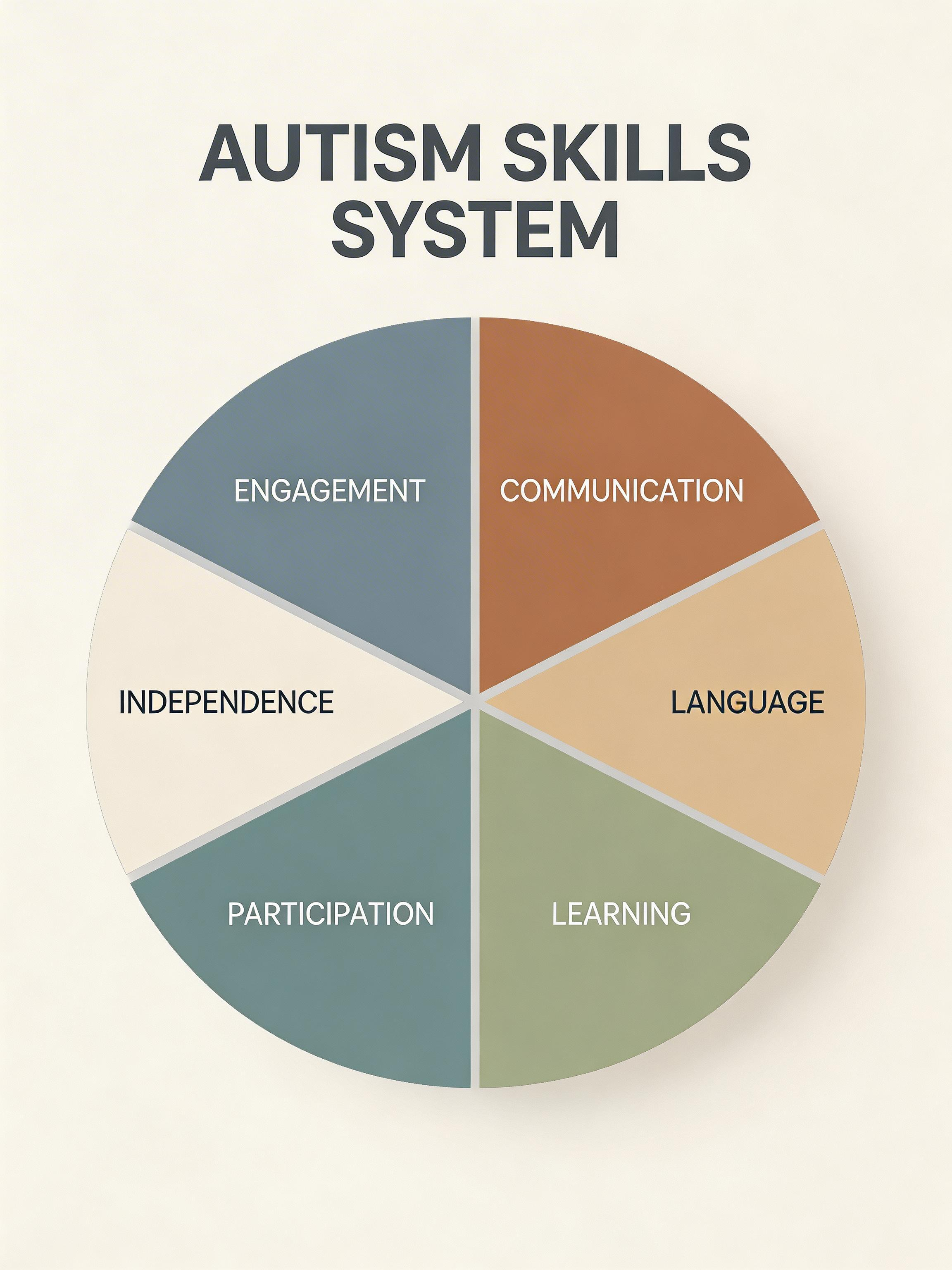
For the full framework connecting communication to the other five developmental domains, the Autism Skills System Quick Map shows how everything fits together.