Play is how children learn to think flexibly, interact socially, solve problems, and regulate emotions. When play is limited or rigid, these downstream skills are affected — not because the child is not trying, but because the learning engine that drives them is running at reduced capacity.
This guide covers what play stages matter for autistic children, how to expand rigid play patterns, practical teaching strategies, and how play connects to peer interaction and school readiness.
Why play matters more than it looks
Play is frequently treated as a reward, a break, or a nice-to-have. In developmental terms, it is none of those. Play is the primary context in which children develop flexibility, problem-solving, social referencing, and shared imagination.
When an autistic child’s play is limited to a few repetitive actions — lining up objects, spinning wheels, rewinding the same video clip — the issue is not that the child is doing something wrong. The issue is that a critical learning channel is narrowed.
Expanding play does not mean eliminating the child’s interests. It means gradually building more varied, flexible, and social play from whatever the child already enjoys.
Play stages: where to start
Play develops in stages, and each stage builds on the previous one. Skipping stages — jumping straight to pretend play, for example — usually produces scripted performance rather than genuine skill.
Exploratory play
The child investigates objects through senses — mouthing, banging, shaking, spinning, dropping. This is the earliest stage and provides the sensory foundation for later play.
Teaching focus: Introduce new textures, sounds, and materials. Join the child in exploring rather than redirecting. If the child bangs a block, bang your own block next to them.
Functional play
The child uses objects for their intended purpose — rolling a car, stacking blocks, putting a phone to their ear. This represents a cognitive shift from “what does this feel like?” to “what is this for?”
Teaching focus: Model functional use alongside the child. If the child holds a spoon, demonstrate stirring. If they hold a car, push yours along the ground. Keep it brief and follow their lead.
Constructive play
The child creates something — a tower, a track, a drawing, a structure. This requires planning and sequencing.
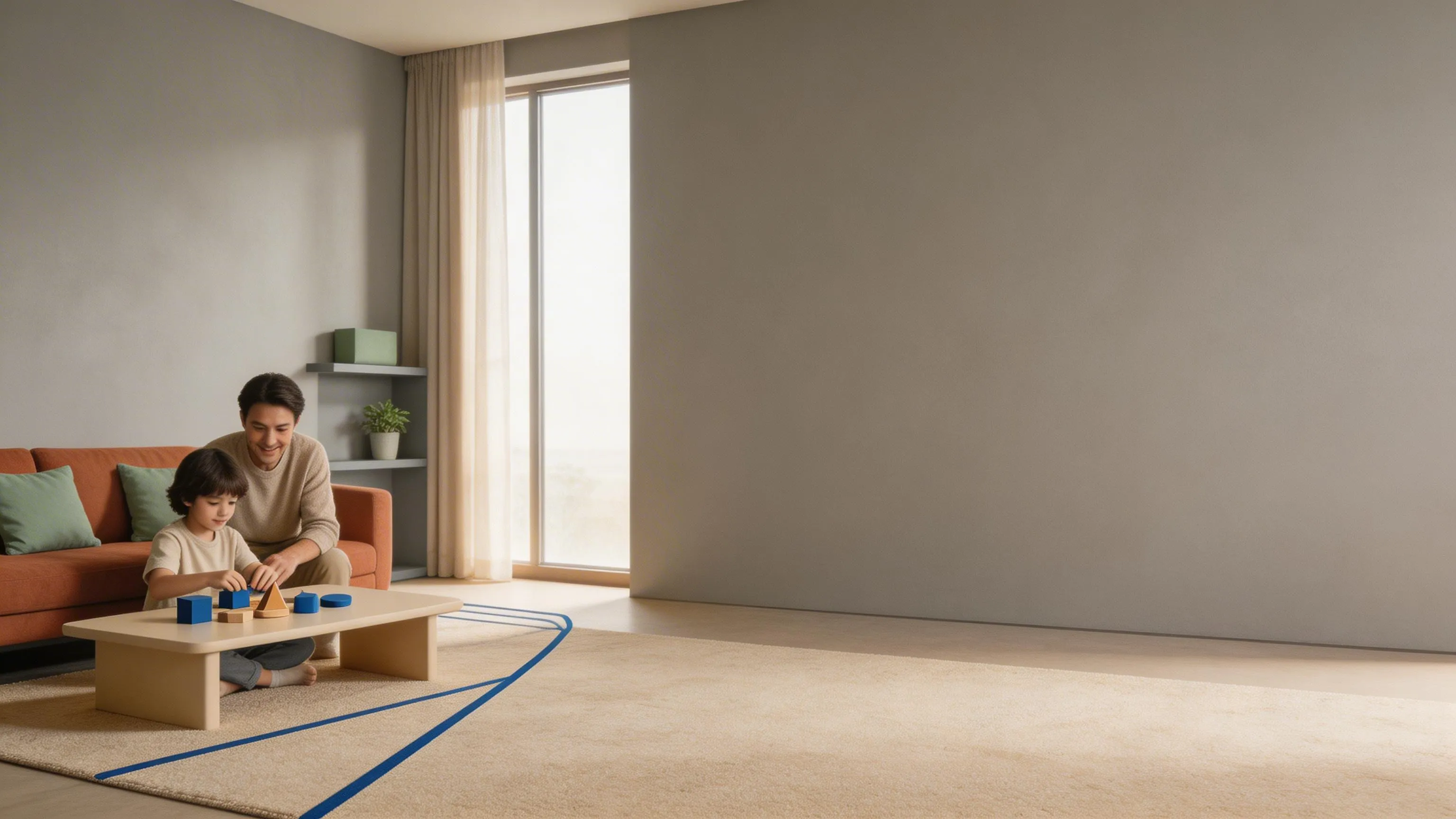
Teaching focus: Build alongside the child. Start simple: “I’ll add one block to your tower.” Gradually introduce collaborative building where you take turns adding pieces.
Social play
The child engages with peers — parallel play (playing near someone), associative play (sharing materials), or cooperative play (working toward a shared goal).
Teaching focus: Start with parallel play. Two children at the same table with the same materials, no expectation of interaction. Then gradually introduce shared materials and simple turn-taking structures.
Pretend play
The child uses imagination — a block becomes a phone, a box becomes a car, dolls have conversations. This requires symbolic thinking and is one of the later-developing play skills.
Teaching focus: Only introduce after earlier stages are in place. Begin with functional pretend (feeding a doll, putting a teddy to bed) before abstract pretend (the block is a spaceship).
How to expand rigid play patterns
Rigid play is not bad play. It is play that has settled into a narrow channel because that channel is comfortable and predictable. The goal is to widen the channel, not dam it.
Join before redirecting
The first and most important step is to enter the child’s play world on their terms. If they line up cars, sit down and line up your own cars. If they spin a wheel, spin a wheel near them. This builds shared attention and trust before you introduce any variation.
Add one small variation
Once you are inside the play routine, change one element. If the child always lines up red cars, add a blue car to the line. If they always build the same tower, add a different block on top. One change. Not three. Not a complete redirection.
Watch the child’s response. If they tolerate the variation, stay there for several sessions before introducing another change. If they resist, back off, restore the routine, and try a smaller variation next time.
Use the child’s interests as a bridge
Restricted interests are not obstacles to play development — they are the entry point. A child obsessed with trains can learn turn-taking with train tracks. A child who loves letters can engage in constructive play by building words with blocks. A child fascinated by water can explore cause-and-effect through water play.
The interest provides motivation. The adult provides structure that gradually expands what happens within that interest.
Play and flexibility
Play is one of the best contexts for teaching flexibility because the stakes are low and the motivation is high. A child who cannot tolerate a change in their morning routine might tolerate a change in a play scenario — because play does not carry the same anxiety load.
Use play to practice:
- Small changes to routines. The train goes a different route today. The blocks get stacked in a new order. The doll sits in a different chair.
- Unexpected events. The tower falls! The car crashes. The puzzle piece goes in the wrong spot. Model calm reactions and problem-solving.
- Multiple solutions. “The bridge is broken. How else can the car get across?” Encourage the child to try a different approach.
These are not drills. They are play moments where flexibility happens naturally because the context is enjoyable and the consequences of “failure” are zero.
For strategies on building flexibility more broadly, read How to Build Flexibility Without Chaos.
Play and peer interaction
Many parents want their autistic child to “play with other kids.” But unstructured free play with peers is actually the hardest social context, because it requires real-time reading of social cues, negotiation, rule-following, and adaptation.
A more realistic progression:
Step 1: Parallel play. The child plays near a peer with similar materials. No interaction required. Success = tolerating the peer’s presence.
Step 2: Structured sharing. The children share materials within a structured activity — building a tower together with assigned turns, rolling a ball back and forth.
Step 3: Cooperative play. The children work toward a shared goal with simple roles — one child pushes the train, the other builds the track.
Step 4: Semi-structured free play. A play scenario with a theme but room for improvisation — playing “restaurant” or “building site” with loosely assigned roles.
Each step can be practiced at home with siblings, during playdates with one peer, or in small group settings at school or therapy.
For the foundational skill that makes all peer play possible, read How to Build Shared Attention Before Table Work.
How the handbook covers play
Chapter 17 of the Autism Skills Handbook provides a complete play skills framework — from exploratory play through social and pretend play — with practical teaching strategies for each stage. The chapter covers how to identify where a child is in the play progression, how to expand rigid patterns, and how to use play as a vehicle for teaching flexibility, social engagement, and problem-solving.
The Play and Flexibility Planner helps you set realistic play goals and track progress across play stages.