
Parents preparing autistic children for school are often told to focus on letters, numbers, shapes, and colors. This advice is well-meaning and almost entirely wrong.
The skills that predict whether an autistic child can succeed in a school environment have very little to do with academic content and everything to do with participation — the ability to function within a group, follow shared instruction, tolerate transitions, and learn by watching other children.
What school readiness actually means for autistic children
School is a group environment. The fundamental shift from home-based or 1:1 therapy to school is the shift from individual attention to shared instruction. A teacher cannot stop the class to give one child a separate explanation, a personal visual schedule, and three attempts at a transition cue.
This means the skills that matter most for school readiness are:
Group instruction following. Can the child respond to directions given to the whole group, not just to them individually? “Everyone sit down” is fundamentally different from an adult touching the child’s shoulder and saying “Sit down, Marcus.”
Transition tolerance. Schools involve constant transitions — between activities, between rooms, between adults. A child who melts down at every transition will struggle regardless of academic ability.
Observational learning. Can the child pick up information by watching what other children do? In a classroom, much of learning happens indirectly — watching a peer answer a question, observing how others line up, noticing what happens when someone raises their hand.
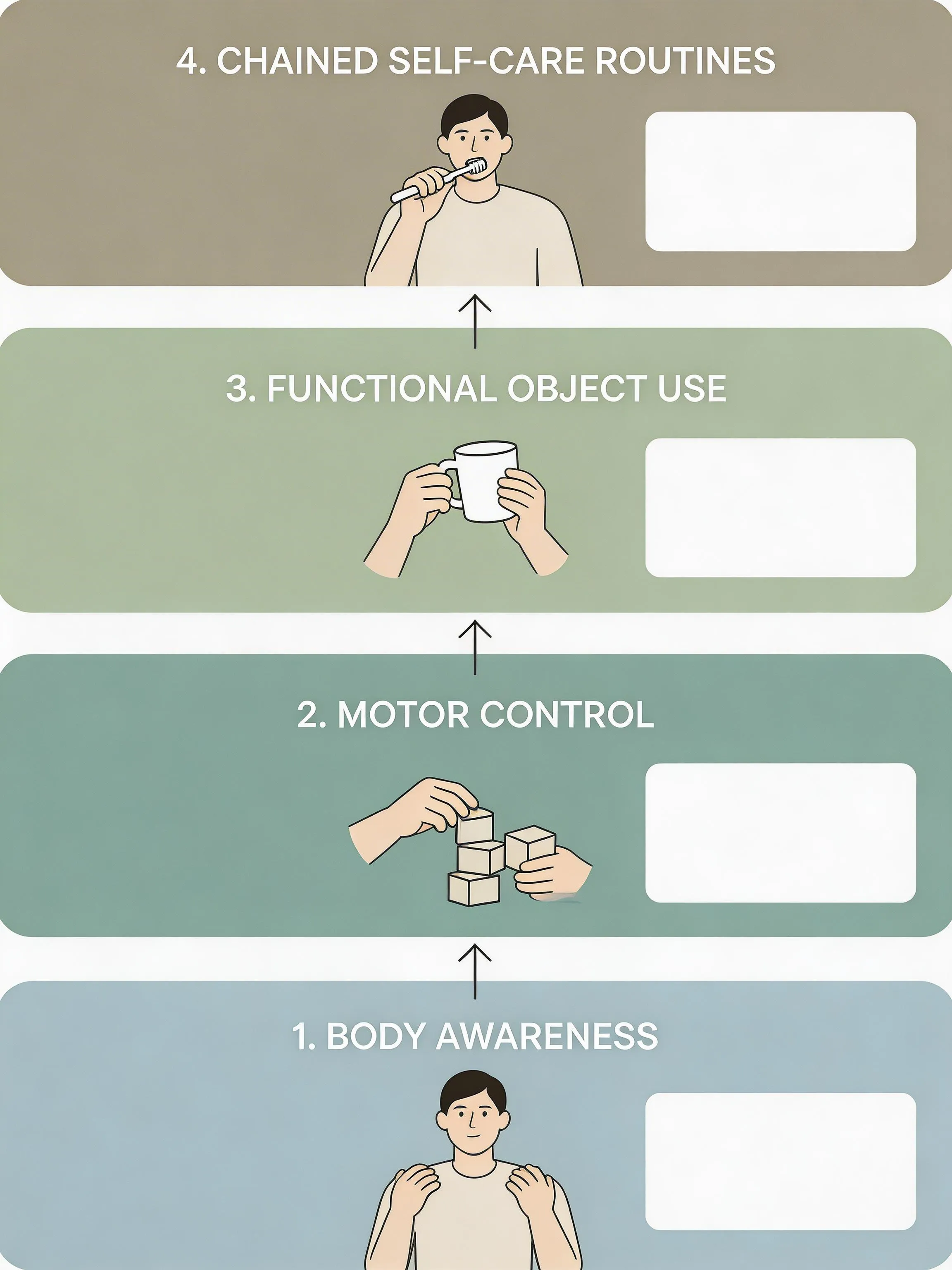
Basic self-help. Toileting, eating without constant help, managing a backpack, putting on shoes. These are not academic skills, but they determine whether the child can participate in the school routine without constant 1:1 adult support.
Flexibility. The school schedule will not be identical every day. Assemblies happen. Substitutes appear. Fire drills interrupt. The child needs enough flexibility to tolerate at least minor routine changes without extended distress.
Skills that matter before academics
Before worrying about whether your child can count to 20 or recognize their name, focus on these foundational participation skills:
Shared attention in a group
Can the child look at what the teacher is showing the whole class? Can they orient to a group demonstration? This is different from shared attention with one adult — it requires filtering out distractions and tracking a less personally directed signal.
Following multi-step routines
School runs on routines. Arrival routine, circle time routine, snack routine, bathroom routine, pack-up routine. A child who can follow a 3-step sequence without individual prompting at each step is prepared for the rhythm of school.
Waiting and turn-taking
Not indefinite waiting, but the ability to wait briefly while another child has a turn, while the teacher finishes with someone else, or while a preferred activity is being set up. Even 30 seconds of independent waiting is a meaningful skill in a classroom.
Learning from peers
This is one of the most underappreciated school readiness skills. A child who can watch another child complete a task and then attempt it themselves has access to a massive learning channel that operates all day. A child who only learns from direct adult instruction misses most of what school offers.
The article Can Autistic Children Learn by Watching? covers the research and practical strategies for building observational learning.
Tolerating imperfection
School involves things going wrong — a dropped crayon, a cancelled activity, a peer taking a preferred seat. The child does not need to be happy about these events, but they need to be able to recover from them without extended disruption.
Assessing readiness without guessing
Instead of relying on gut feeling or standardized checklists designed for neurotypical development, assess readiness by observing your child in contexts that resemble school demands.
Practical observation questions:
- In a group of 3-4 children, does your child follow a direction given to the group?
- Can your child transition between activities with a visual cue and without physical prompting?
- Does your child notice and imitate what other children are doing, even occasionally?
- Can your child manage basic self-care tasks with only verbal reminders (not physical help)?
- When something unexpected happens, can your child recover within a few minutes?
If the answer to most of these is yes, the child likely has the participation foundation for a school setting. If the answer to several is no, those specific skills should become priority targets before academic preparation.
Preparing at home
You do not need to create a classroom at home. You need to practice the specific skills school demands, using the routines you already have.
Group instruction practice. When you are with your child and another family member, give instructions to the group: “Everyone come to the table.” Reinforce the child for following the group cue, not just individual directions.
Transition practice. Use visual cues at home to signal transitions: “When the timer goes off, we clean up and go outside.” Start with preferred transitions (moving toward something the child wants) before introducing less preferred ones.
Waiting practice. During meals or play, build in brief waiting moments. “I need to get the cups. Wait right here.” Start with 10 seconds and build gradually.
Routine sequences. Create a 3-step visual routine for one daily activity (morning routine, snack time, getting ready for bed) and practice following it with decreasing adult support.
For a structured approach to building shared attention skills before school, read How to Build Shared Attention Before Table Work.
How the handbook covers school readiness
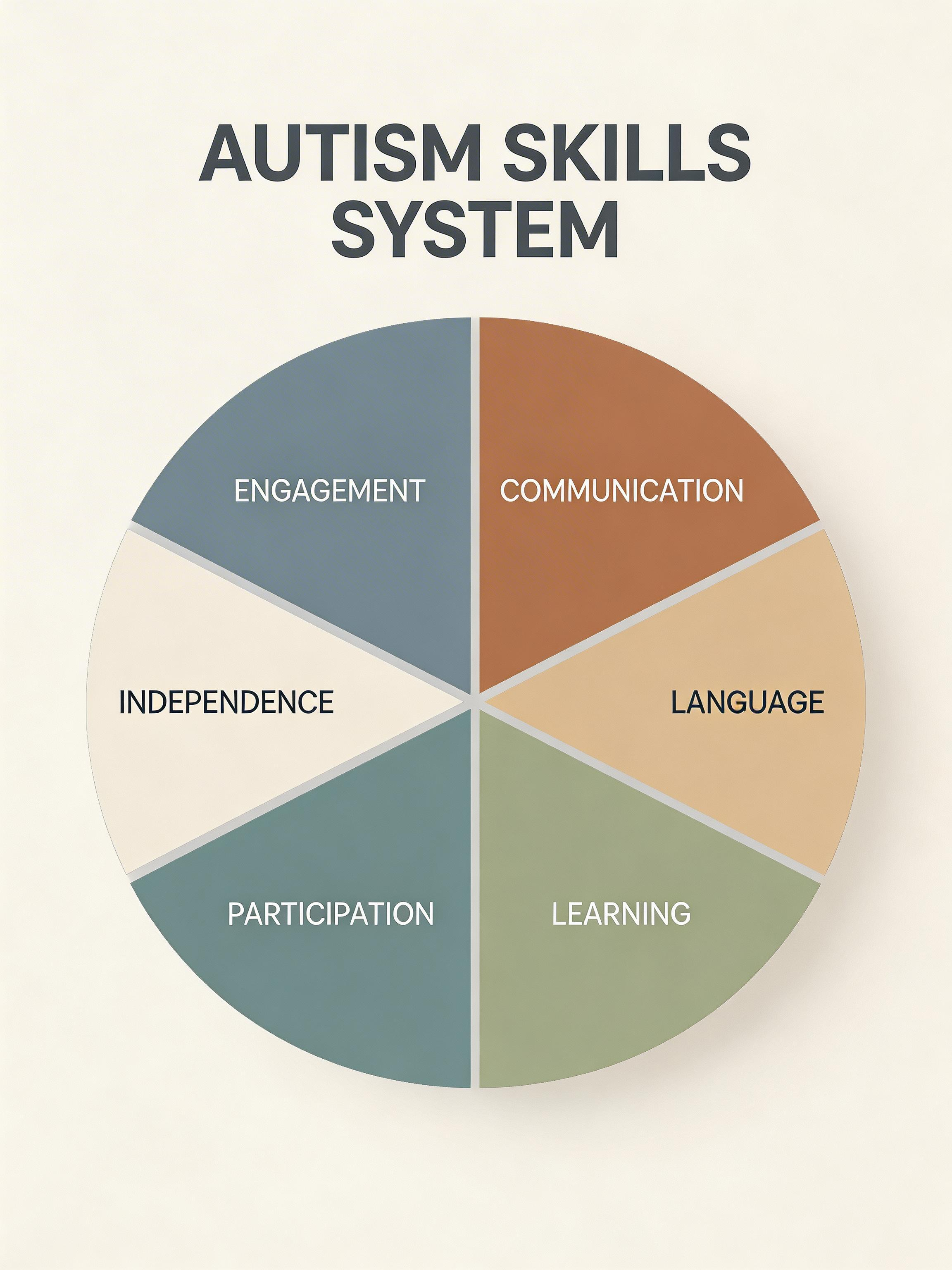
Chapter 20 of the Autism Skills Handbook provides a complete school readiness framework organized around participation skills rather than academic milestones. Chapter 17 covers play and group learning — the social foundation that school environments depend on.
The School Readiness and Group Learning Checklist provides a structured assessment tool for evaluating where your child stands on the skills that actually predict school success.
If you are weighing placement decisions or preparing for an IEP meeting about school transition, the Autism School Readiness Checklist article provides a focused overview of the key considerations.