Choosing an ABA provider is one of the most consequential decisions parents make after an autism diagnosis. It is also one of the most confusing, because the field has enormous quality variation that credentials alone do not predict.
This guide gives you the specific questions to ask, patterns to look for, red flags to watch for, and a framework for evaluating whether a program is actually working for your child.
Why choosing is harder than it looks
The ABA therapy field has grown rapidly, and that growth has outpaced quality control. A BCBA credential tells you someone completed specific coursework and passed an exam. It does not tell you whether they design individualized programs, supervise sessions meaningfully, involve parents, or produce outcomes that transfer beyond the therapy room.
The practical reality is that two ABA programs operating in the same city, with the same credentials on the wall, can deliver wildly different experiences for children and families. One may be thoughtful, individualized, and focused on meaningful skills. The other may be a high-volume operation running the same curriculum for every child with minimal oversight.
Parents are not expected to be ABA experts. But you are the person who sees your child every day, and you have the right — and the responsibility — to evaluate whether what is happening in therapy is producing real change.
Questions to ask before starting
These questions separate thoughtful providers from those running on autopilot.
About supervision
- How often does the BCBA directly observe therapy sessions? Monthly is minimum. Biweekly is better. If the BCBA only reviews data without watching sessions, that is not real supervision.
- What happens after an observation? Does the BCBA make program adjustments? Provide feedback to the therapist? Update goals? Observation without action is performance, not supervision.
- Who designs the program? The BCBA should be the primary program designer, with goals individualized to your child’s profile. If the program comes from a standardized curriculum with minimal customization, that is a concern.
About goals and approach
- How do you choose which goals to work on? Look for answers that reference the child’s daily life, not just developmental checklists. Good providers choose goals based on what would change the most for the child, not what is easiest to measure.
- How do you plan to involve parents? Parent training should be a core part of the service, not an afterthought. If you are expected to drop off your child and pick them up without learning what happened or how to support it at home, the model is incomplete.
- What does your prompt fading plan look like? If the provider cannot describe how they move children from prompted to independent performance, prompt dependence is a risk.
About the bigger picture
- How do you coordinate with other providers? If your child has a speech therapist, an OT, or a school team, the ABA provider should be communicating with them. Isolated therapy creates fragmented support.
- What does a typical session look like? Visit before committing. Watch a session. Is the child engaged or compliant? Is there joy in the interaction or only obedience?
Red flags to watch for
These patterns do not automatically mean the provider is bad, but they should prompt serious questions.
- The BCBA is rarely present. If sessions are primarily run by technicians with infrequent BCBA oversight, the program is under-supervised.
- Goals never change. If the same goals have been on the plan for 6+ months with minimal progress and no adjustments, the program is on autopilot.
- Heavy reliance on tangible reinforcers. If every correct response earns an M&M or iPad time, with no plan to fade to natural reinforcement, the child is learning to perform for rewards rather than developing intrinsic skills.
- Focus on compliance over competence. Programs that prioritize sitting still, quiet hands, looking at me, and complying with adult demands over functional communication, independence, and daily living skills have misplaced priorities.
- No parent training. If you have never been trained on how to support your child’s goals at home, a critical piece of the program is missing.
- Cannot explain the “why.” If a therapist or BCBA cannot explain why a specific goal was chosen or why a specific approach is being used, they may be following a template rather than thinking about your child.
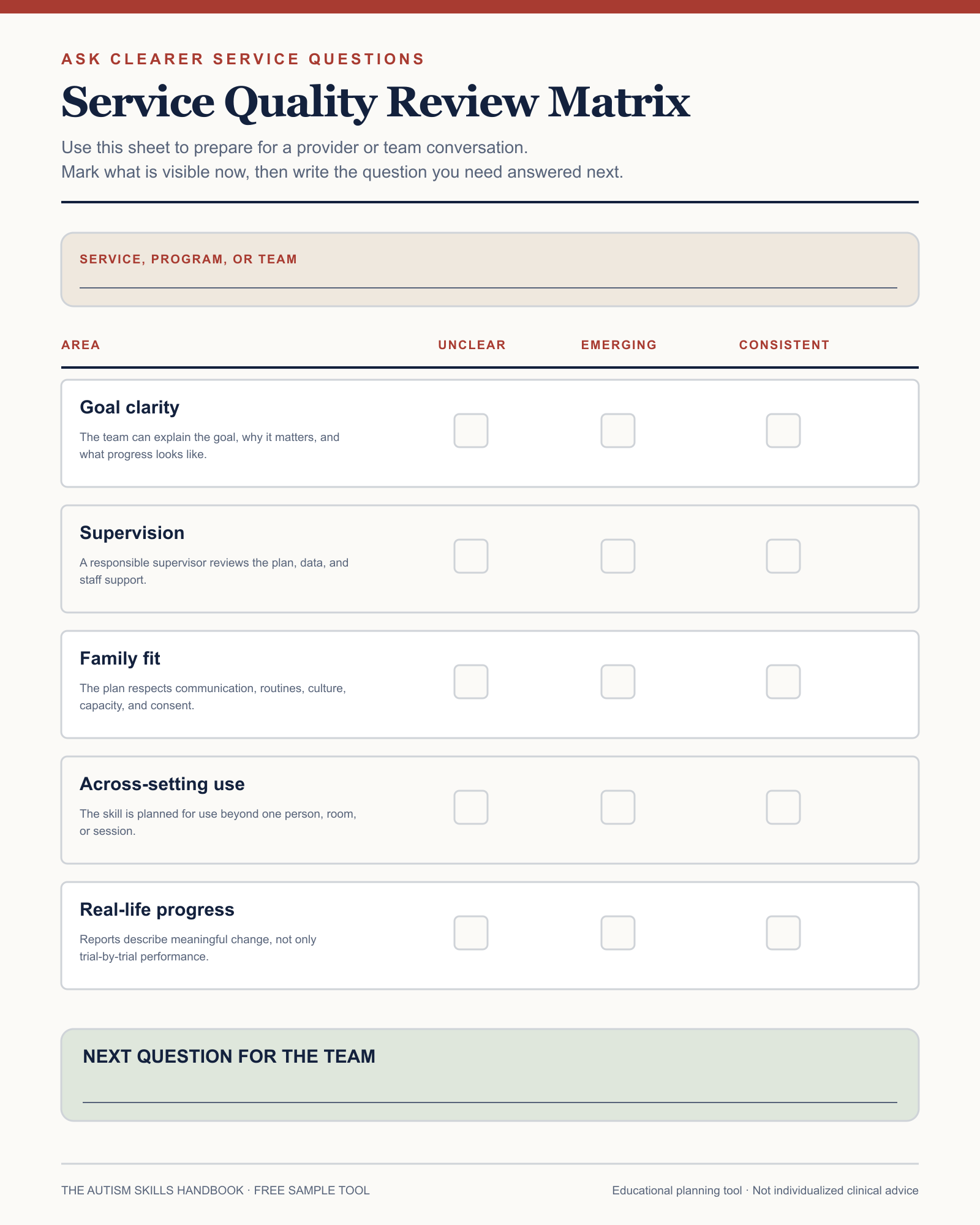
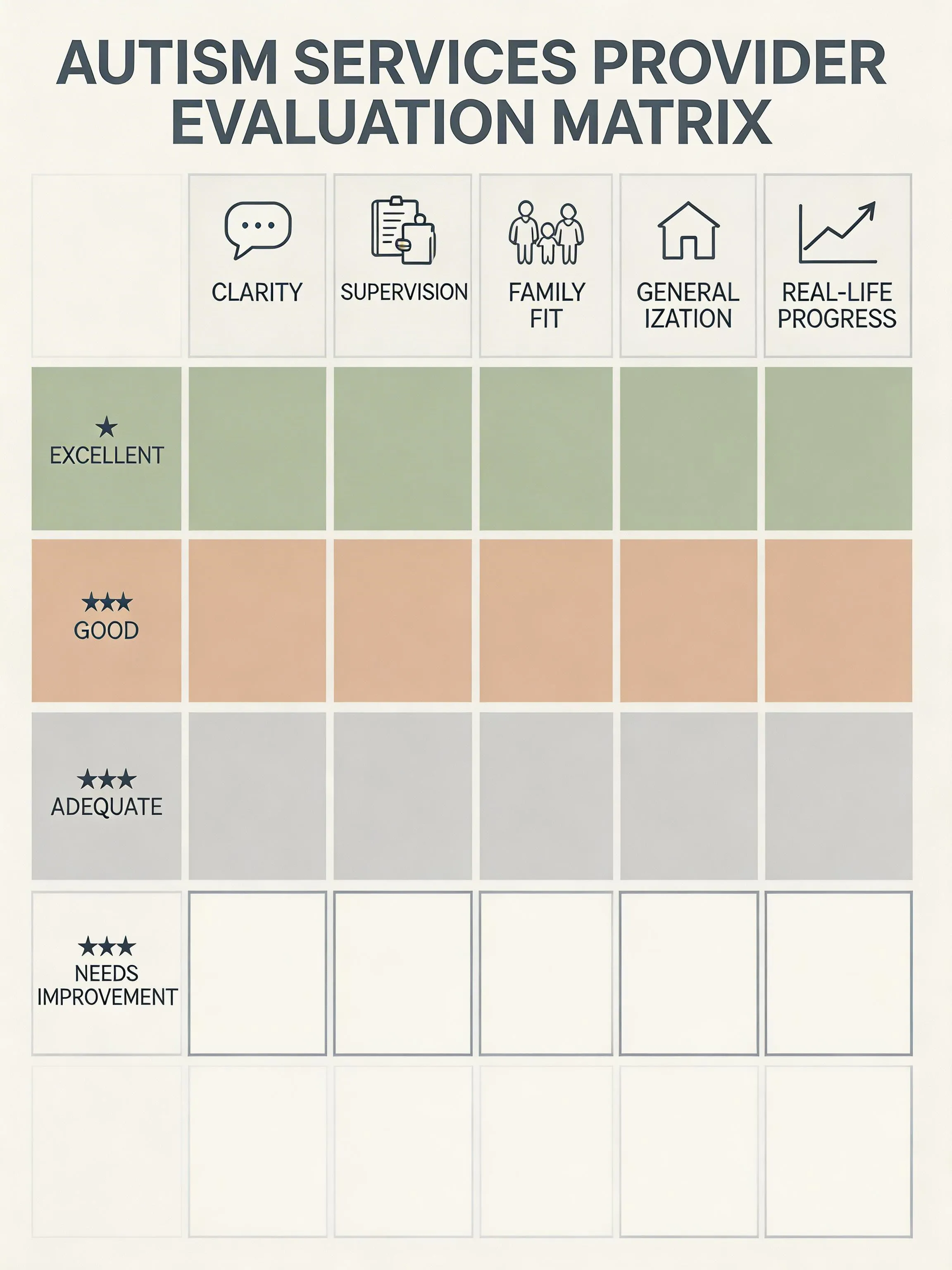
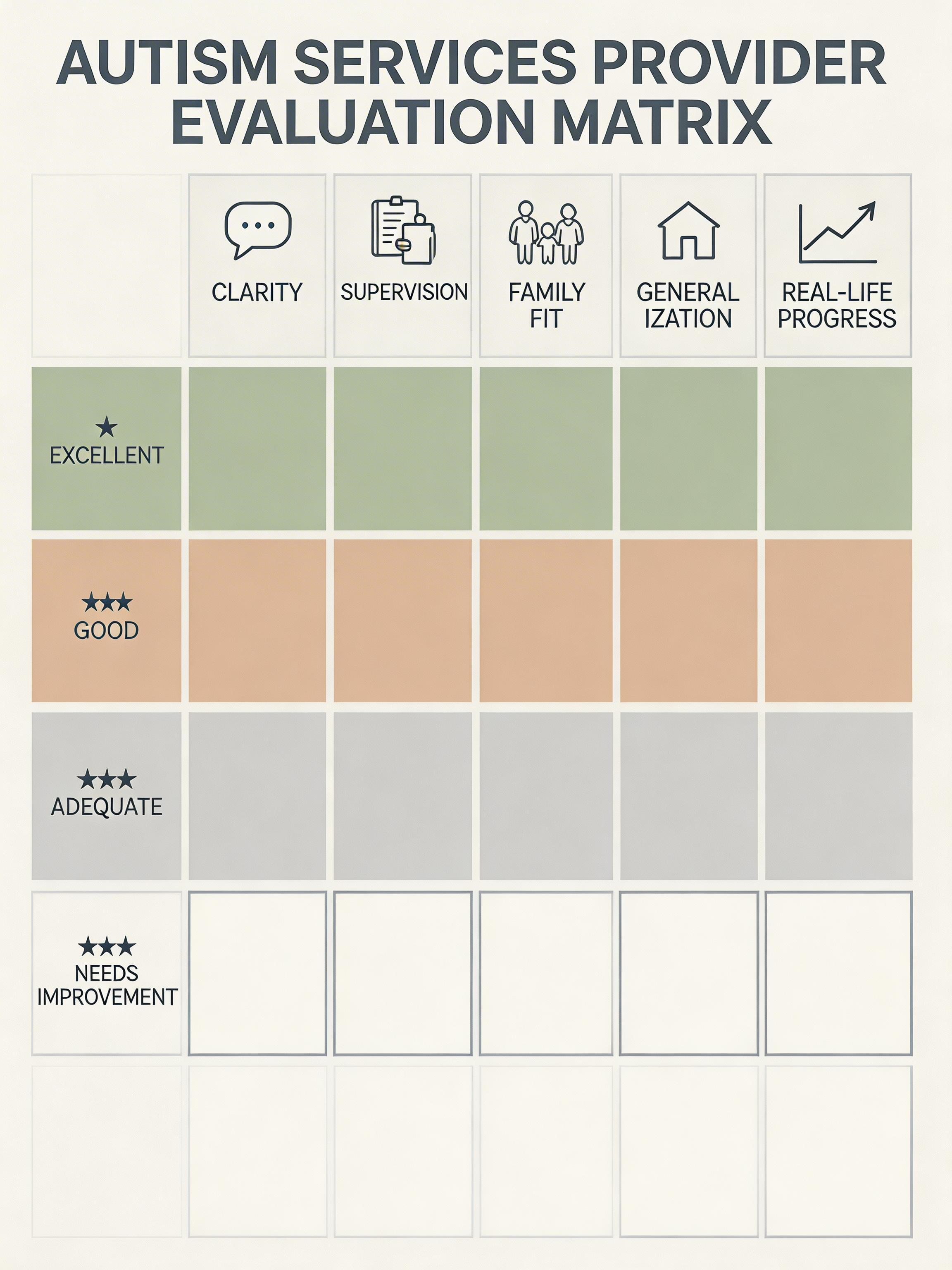
Download the Service Quality Review Matrix for a structured evaluation tool you can use during observations and meetings.
Evaluating ongoing quality
The initial assessment matters, but ongoing evaluation is even more important. Programs that start well can drift.
Monthly check questions:
- Is my child communicating more effectively than a month ago?
- Is my child more independent with any daily routine?
- Has the BCBA observed sessions and made adjustments?
- Have I been trained on anything new?
- Does my child seem engaged during sessions — or are they just complying?
Quarterly review questions:
- Which goals have been met and replaced with new ones?
- Are skills generalizing to home, school, and community?
- Has the program intensity been adjusted based on progress?
- Am I more confident as a parent, or more confused?
If progress is only visible in session data but daily life has not changed, the program needs adjustment — not more time.
When to change providers
Changing providers is disruptive, so it should not be done lightly. But staying with a poor provider is more harmful than the disruption of switching.
Consider changing when:
- Multiple conversations about concerns have produced no changes
- The BCBA cannot articulate a clear rationale for the program direction
- Your child shows signs of prompt dependence or increasing rigidity
- Parent involvement is consistently excluded despite your requests
- Your gut tells you something is wrong — and the data supports it
You do not owe a provider loyalty. You owe your child effective support.
How the handbook helps with service decisions
Chapters 4 and 22 of the Autism Skills Handbook provide a complete framework for building and evaluating a support team, including specific criteria for judging service quality, questions to ask at every stage, and decision tools for knowing when to adjust or change course.
The Service Quality Review Matrix is a free download that gives you a structured tool for evaluating any provider against the criteria that matter most.