Imitation is not just about copying. It is one of the primary systems through which children get pulled into development.
A child who imitates flexibly does not need every skill taught one by one. They can watch someone do something, try it themselves, and get better with practice. That ability changes the economics of learning: instead of needing direct instruction for every single skill, the child starts picking things up from the environment.
For many autistic children, this system develops slowly or unevenly. That is not a minor gap. It affects language, play, social learning, independence, and daily life. When imitation is weak, everything else has to be taught harder.
Why imitation matters so much
Think about how much a typical child learns by watching:
- how to use a spoon by watching a parent
- how to stack blocks by watching a sibling
- how to wave goodbye by seeing it happen at the door
- how to play a game by watching another child
- new words by hearing them used in context
All of this depends on a working imitation system. Not just the ability to copy one specific action, but the ability to notice, store, and reproduce new behavior across many contexts.
When this system is weak, the child misses thousands of incidental learning opportunities every week. Adults have to step in and teach directly what other children absorb naturally. That is why imitation is not just one skill on a checklist — it is a learning multiplier.
Research confirms both the deficit and the teachability. A 2013 study documented a specific imitation deficit in autism that goes beyond general developmental delay. Importantly, a randomized trial by Ingersoll (2010) showed that reciprocal imitation training significantly improved both elicited and spontaneous imitation in autistic children, and a 2006 study found that teaching imitation using naturalistic methods also improved language, pretend play, and joint attention.
The imitation progression
Imitation develops in levels. Each level builds on the one before it.
Level 1: Simple object actions
The child copies a single action with an object. Push the car. Bang the drum. Shake the rattle. These are the easiest because the object produces a visible, often interesting effect. The car rolls. The drum makes noise. The result is its own reward.
Level 2: Varied object actions
The child copies different actions with different objects. Not just pushing every toy, but pushing the car, stacking the block, shaking the bell. This is where variety enters — the child learns that the action changes depending on what the adult does, not just which object is present.
Level 3: Discrimination between actions
The child responds differently when the adult demonstrates different actions with the same object. The adult taps the drum — the child taps. The adult rolls the drum — the child rolls. If the child keeps tapping regardless of what the adult does, the imitation looks like it is working but the discrimination is weak.
This is one of the most commonly missed problems. A child who repeats the same action regardless of the model has learned a routine, not imitation.
Level 4: Simple body actions
The child copies actions involving their own body. Clap hands. Touch head. Stamp feet. These are harder than object actions because there is no external effect to see — the child has to map what they see the adult do onto their own body.
Level 5: Delayed imitation
The child copies an action after a brief delay. The adult shows the action, waits a few seconds, then the child reproduces it. This matters because real life operates on delay. A child who can only imitate during the exact moment of demonstration has a narrow system.
Level 6: Short action sequences
The child copies two or three actions in order. Put the block in the cup, then shake the cup. Load the truck, then dump it. This is where imitation begins to look like real learning — the child is holding a sequence in memory and reproducing it.
Level 7: Vocal imitation
The child copies sounds, syllables, or words. Vocal imitation is particularly important for spoken language development but depends on having the motor capacity and attention to attempt it. Not all children reach this level through the same pathway — some benefit from AAC while vocal imitation develops.
Level 8: Observational learning
The top of the ladder. The child learns by watching what happens to someone else. They see a peer get praised for raising their hand, and they raise their hand. They see a sibling get a treat for putting shoes on, and they try it. They do not need to be directly taught — they extract the lesson from watching.
This is where imitation becomes its most powerful. A child with strong observational learning gains more from every environment because they are learning from everything around them, not just from direct instruction.
How to build it at home
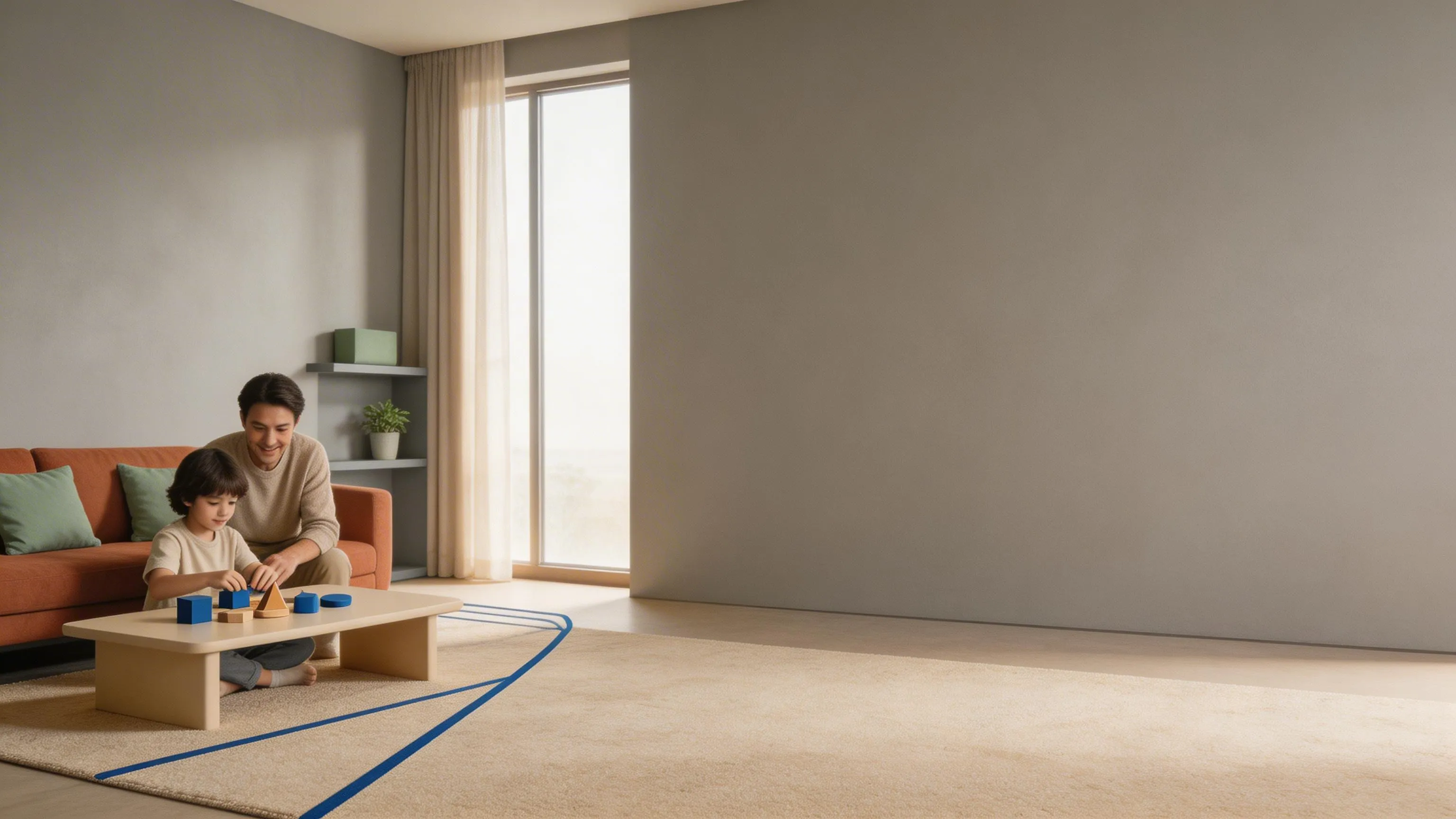
You do not need special equipment. You need attention, patience, and the right starting point.
Start with objects that produce effects
Choose toys or objects where the action creates something interesting. A car that rolls down a ramp. A tower of blocks that crashes. A drum that makes noise. A wind-up toy that moves.
Show the action. Pause. Let the child try. If they do something close, celebrate and keep going. If they need help, guide gently and try again.
The key at this stage: the action itself should be fun. If the child enjoys the effect, they will want to repeat it. That internal motivation is more powerful than any external reward.
Build variation
Once the child can copy a few object actions, start mixing them up. Do not let sessions become one-action routines. If the child has been pushing cars all week, switch to banging drums. Then stacking blocks. Then shaking bottles.
The variety teaches the child to watch what the adult does rather than repeat what they did last time. That shift — from routine to observation — is the crucial development.
Check discrimination
This is the step most families and programs skip. The child copies “tap the drum” successfully. Good. Now show “roll the drum.” Does the child roll, or do they tap?
If they tap, the problem is not motivation or refusal. It is discrimination — the child is defaulting to the most practiced response. The fix is not correction. It is building clearer contrasts between actions until the child starts watching more carefully.
Add delay
Once the child imitates reliably in the moment, start building a brief gap. Show the action. Wait three seconds. Then signal the child to try. Gradually extend the gap.
This develops the memory component that makes imitation useful in real life. A child who remembers what they saw at the park and tries it at home is using delayed imitation. A child who only copies in the exact teaching moment has a narrower system.
Move into daily routines
Imitation should not stay at the therapy table. Build it into daily life:
- During cooking: stir, pour, wipe
- During cleaning: sweep, pick up, put away
- During dressing: pull sleeve, zip, push foot into shoe
- During play: stack, crash, chase, hide
- During mealtimes: scoop, drink, wipe mouth
Every daily routine contains actions worth imitating. The child who starts copying these actions without being asked is showing that the imitation system is becoming generalized.
When progress seems stuck
If imitation is stalling, check these common problems:
The child is perseverating on one action. They keep doing the same thing regardless of what you model. This is a discrimination problem, not a refusal. Build sharper contrasts between actions.
The actions are too abstract. Body movements without visible effects (touch your nose, clap your hands) may be too hard as a starting point. Return to objects.
Not enough repetition. Early imitation needs many repetitions of the same game before the child truly owns it. Do not move too fast.
Too much prompting. If you physically guide the child through every action, they may learn to wait for help rather than watch and try independently. Give the lightest prompt possible and fade it as quickly as you can.
The model is not clear enough. Show the action with exaggerated movement, close to the child, with minimal distraction. Make it easy to notice.
When imitation opens up, everything changes
A child with flexible imitation is a child who can learn faster, in more contexts, with less direct support. Language, play, social skills, self-care, and independence all become more accessible because the child has a system for acquiring new behavior from the environment.
This is why imitation is not just one item on a goals list. It is infrastructure. Building it well changes the trajectory of everything that follows.
For the full imitation teaching protocol, progression ladder, and troubleshooting framework, see the book.