
Prompt dependence is one of the most common and least discussed problems in autism education. It develops quietly, looks like compliance from the outside, and can persist for years before anyone recognizes it as a barrier.
This guide explains what prompt dependence is, why it develops, how to spot it, and what to do about it — whether you are a parent noticing patterns at home or a professional evaluating a program.
What prompt dependence is
A prompt is any cue an adult provides to help a child perform a skill — a verbal instruction, a gesture, a physical touch, a model to imitate. Prompts are essential teaching tools. The problem is not prompting itself. The problem is when prompts become permanent.
Prompt dependence means the child waits for an adult cue before responding, even when they are capable of performing the skill without help. The child has not learned the skill — they have learned to wait for the prompt.
From the outside, prompt dependence can look like success. The child performs the skill. Data sheets show correct responses. But the skill only appears when an adult provides the cue. Remove the adult, and the skill vanishes.
This matters because the entire point of teaching is independence. If a child can only perform a skill when prompted, they have not acquired the skill — they have acquired a response chain that requires an adult to initiate it.
How prompt dependence develops
Prompt dependence is almost always built by the teaching environment, not caused by the child’s disability. It develops through predictable patterns:
Prompting too quickly. When adults jump in with a prompt before the child has a chance to respond independently, the child learns to wait. Why initiate when someone will always tell you what to do?
Prompting too heavily. Using physical guidance or full verbal instructions when a lighter prompt would work teaches the child to rely on maximum support. The skill becomes entangled with the prompt level.
Not fading systematically. Many programs introduce prompts but have no plan for removing them. The prompt becomes part of the routine, and removing it feels like removing a piece of the task itself.
Reinforcing prompted responses the same as independent ones. If a child receives identical feedback whether they initiated independently or waited for a prompt, there is no incentive to initiate. The prompt-wait strategy is easier and works just as well.
Adult proximity as an implicit prompt. Sometimes the mere presence of a familiar adult functions as a prompt. The child has learned: when this person is standing near me, I should do this thing. When they leave, the cue is gone.
For a focused list of warning signs in programming, read Signs a Program Is Building Prompt Dependence.
Signs it is already building
You do not need to be a behavior analyst to spot prompt dependence. Look for these patterns:
At home:
- The child looks at you before starting any task, even familiar ones
- Skills that work perfectly with you present disappear when you leave the room
- The child waits at each step of a routine for your verbal cue before proceeding
- You find yourself saying “Come on, you know how to do this” frequently
In therapy or school:
- Data shows high accuracy, but the child never initiates the skill without a cue
- The child performs differently with different adults — not because of the relationship, but because of different prompting styles
- Progress stalls at the prompted level — the child is “maintaining” but not becoming more independent
- The child’s performance drops dramatically during probe trials (unprompted tests)
The core test: Remove all prompts and see what happens. If the child does nothing, or does something completely different, the skill is prompt-dependent. If the child performs the skill independently after a brief pause, they may just need more practice with initiation — but the skill exists.
How to fade prompts
Prompt fading is the process of gradually reducing adult support so the child performs skills independently. It should be planned from the moment a prompt is introduced, not treated as an afterthought.
The least-to-most principle
Start with the lightest prompt that produces a correct response. If a gesture works, do not use a verbal cue. If a verbal cue works, do not use physical guidance. This reduces the amount of fading required later.
Transfer to natural cues
Every skill has natural cues — environmental signals that indicate what to do without adult involvement. The bell rings: go to class. The plate is empty: take it to the sink. The shoes are by the door: put them on.
The goal of fading is not just to remove the adult prompt but to transfer control to these natural cues. When the child responds to environmental signals rather than adult cues, the skill is truly independent.
Create initiation opportunities
Deliberately set up situations where the child has a chance to start a skill without any adult signal. Position materials, create routines, and then step back. Wait longer than feels comfortable. Many children will initiate if given enough time — the problem is that adults fill the silence before the child gets there.
Differential reinforcement
Give stronger, more immediate reinforcement for independent responses than for prompted ones. The child should learn: when I do this on my own, something better happens.
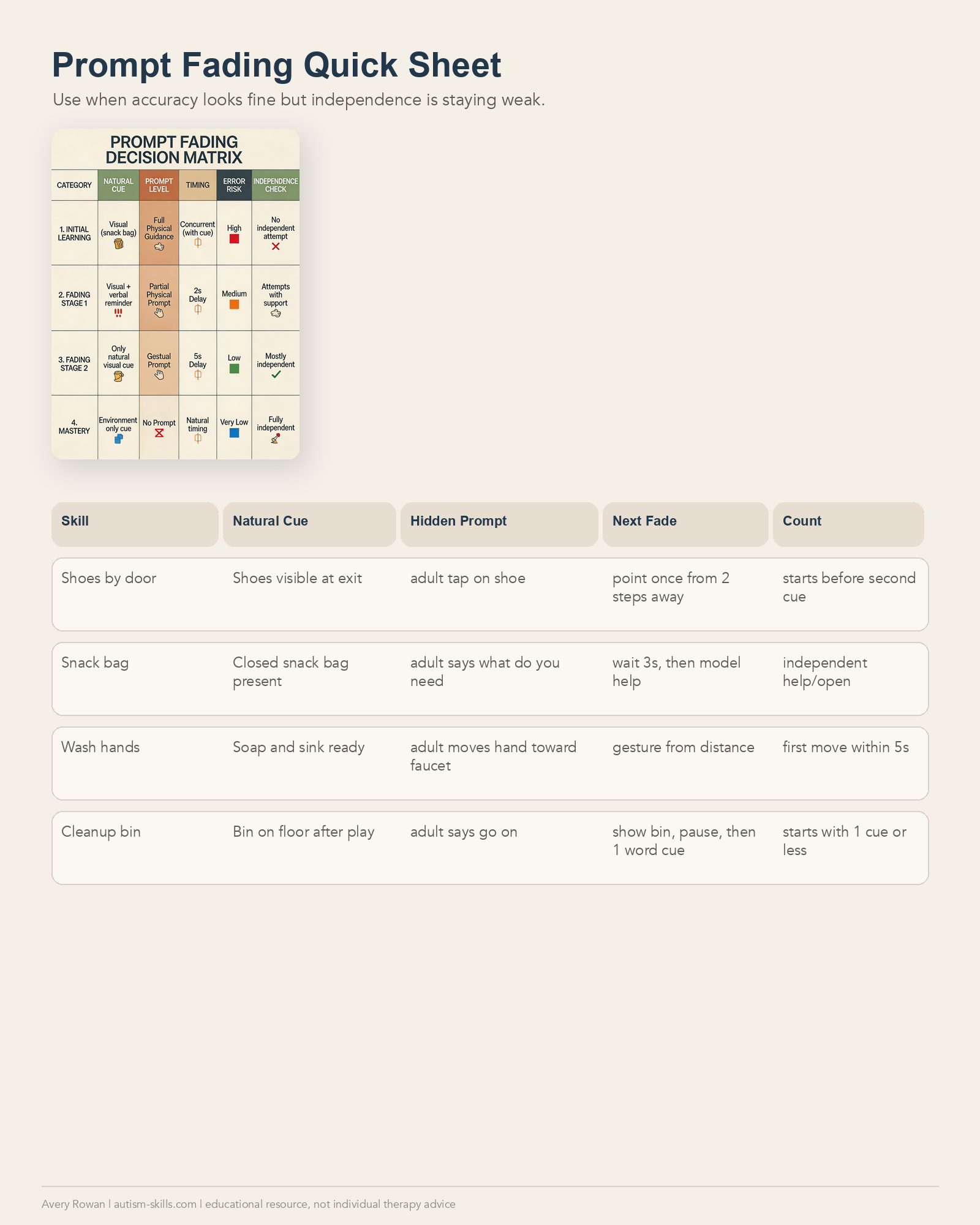
Download the free Prompt Fading Quick Sheet for four worked examples showing natural cues, hidden prompts, and the next fade step for everyday skills.
Preventing prompt dependence from the start
Prevention is far easier than remediation. If you are setting up a new teaching program or starting with a new therapist, these design principles reduce the risk:
- Every prompt should have a fade plan. Before introducing a prompt, decide how it will be removed.
- Build in unprompted trials from day one. Even in early teaching, include opportunities where the child attempts the skill without a cue.
- Monitor independence, not just accuracy. Track what percentage of correct responses are independent. If that percentage is not increasing over time, the program is building dependence.
- Watch for proxy prompts. Adult positioning, eye contact, environmental arrangement — any consistent pattern the child learns to depend on.
- Ask providers about their fading plan. If a therapist cannot explain how they plan to fade prompts for a specific goal, that goal is at risk.
For a deeper exploration of how prompt dependence builds over time and what to look for in a program, read Prompt Dependence in Autistic Children.
How the handbook addresses independence
Chapter 9 of the Autism Skills Handbook provides a complete framework for understanding and preventing prompt dependence, including systematic fading strategies, natural cue transfer, and program design principles that build independence from the start.
The Prompt Fading and Independence Tracker helps you monitor whether skills are becoming more independent over time — the metric that matters more than accuracy alone.