
Play is not a break from learning. For young children, it is where most learning happens.
Attention, turn-taking, anticipation, imitation, flexibility, language, shared enjoyment, cause-and-effect thinking — all of these get built through play. In autism, the areas that are hardest (social engagement, flexibility, shared attention, imitation, symbolic thinking) cluster exactly in the play domain.
That makes play one of the most important teaching targets, not an optional enrichment activity squeezed in after table work. Research supports this: a 2013 review of play interventions for autistic children found that structured play teaching improved both play complexity and related developmental skills. A 1995 study showed that pivotal response training could teach symbolic play skills that then generalized to new toys and settings.
But there is a sequence. And many programs get it backward.
The mistake: starting with scripts
A common approach is to teach pretend play by scripting it. An adult sets up a toy kitchen, hands the child a pot, and walks them through: stir, pour, taste, yum. The child completes the steps. Adults call it pretend play.
But the child may not be engaged. They may not be enjoying the interaction. They may not understand what the actions represent. They are following an adult script in the same way they follow any prompt sequence.
That is not play. That is compliance with toys.
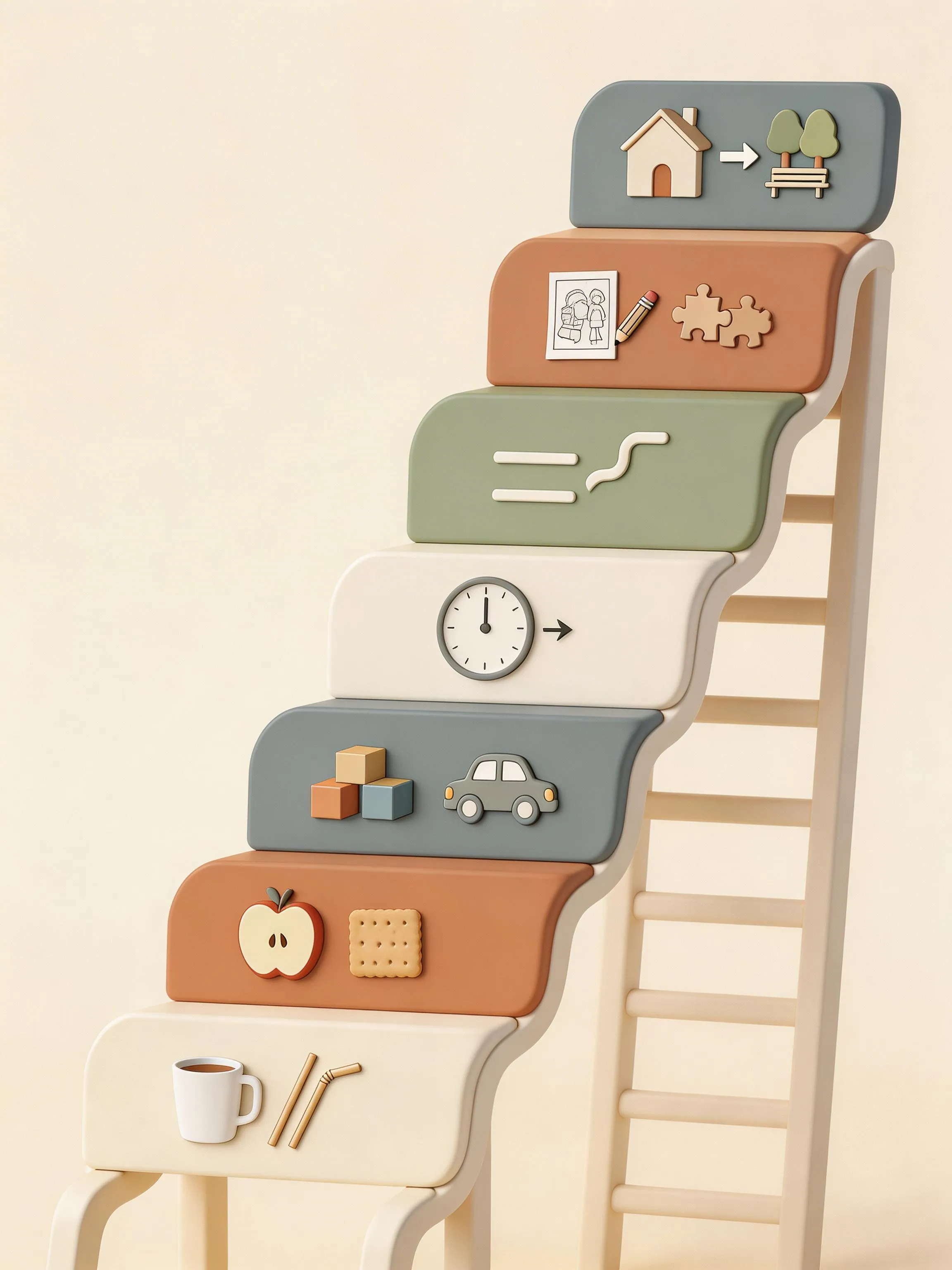
Pretend play sits near the top of a developmental ladder. Skipping the lower rungs creates performance without foundation.
What comes before pretend play
Play develops in a sequence. Each level builds the skills that make the next level possible.
Sensory-social play. The earliest play is body-based, rhythmic, and emotionally vivid. Chase. Tickle. Peekaboo. Blanket swings. Roughhousing. These games are short, exciting, and built around anticipation: the child knows what is coming and wants it to happen again.
This stage teaches something critical: another person is fun. When a child learns to associate an adult with enjoyment, surprise, and rhythm, the adult becomes more relevant. That changes how many learning opportunities the child even notices in a day.
Simple object play. Push a car, stack a block, drop a ball, open a box. The child acts on objects and sees an effect. These are not complex, but they build cause-and-effect understanding and make objects meaningful beyond their sensory features.
Causal play. Press the button and music plays. Push the tower and it falls. Pull the string and the toy moves. These games feed prediction and expectation — the child starts to understand that their actions produce outcomes.
Functional play sequences. Stir and feed. Load the truck and dump it. Put the person in the car and push. These short chains connect two or more actions in a meaningful order. They are the earliest proto-pretend: the child is not just acting on objects but starting to represent something.
Early pretend. The doll sleeps. The animal eats. The block becomes a phone. The child uses one thing to stand for another. This is symbolic, and it matters because symbolic thinking is what language, imagination, and social understanding all depend on.
Shared themes and roles. Store, doctor, restaurant, bus. Two people playing together with assigned roles. This is where play becomes genuinely social and creative.
Flexible pretend. The child tolerates changes to the script, expands the story, adds new elements, and plays differently with different people. This is the top of the ladder.
How to build the early stages
Start with what the child actually enjoys, not what adults think play should look like.
Follow sensory preference. If the child loves movement, start with chase or swing games. If they love deep pressure, start with crash or squeeze games. If they love dramatic reveals, start with peekaboo or hiding games. The child’s body tells you what is rewarding.
Keep it short. Early play interactions should be five to fifteen seconds. Build anticipation, deliver the payoff, pause, and see if the child comes back for more. That return is the engagement you are building.
Use your body, not just toys. For many autistic children, toys are too open-ended, too confusing, or too easy to use repetitively alone. The adult’s body, voice, timing, and movement are often better starting materials than a toy box.
Repeat the game. Repetition is not the enemy at this stage. Repetition makes the game understandable. The child needs to know what is going to happen before they can tolerate changes to what happens. Play the same game until the child clearly expects it. Then change one small thing.
Frame, repeat, stretch. Keep the game frame stable (same start, same basic action, same payoff). Then change one detail. A different sound effect. A longer pause before the crash. A new object in the same game. The child recognizes the game, which makes the variation tolerable.
How to know it is working
Progress in play is not measured by how closely the child matches a typical script. It is measured by:
- Engagement. Does the child orient to you during the game? Do they come back for another round?
- Anticipation. Does the child show they know what is coming next — through body language, eye gaze, laughter, reaching?
- Initiation. Does the child start the game, or restart it when it stops?
- Flexibility. Can the child tolerate small changes without dropping out?
- Shared meaning. Do both people understand what the game is about?
A child who chases you around the couch, laughs at the same point every time, and pulls your hand to restart is showing stronger developmental play than a child who moves toy food from pot to plate because an adult told them to.
What about older children?
Play development does not have an age limit. A six-year-old who is still at the sensory-social level needs sensory-social games, not pretend play scripts. An eight-year-old who loves cause-and-effect can build from there.
The stages do not need to match the child’s age. They need to match the child’s current engagement level. Working at the right level — even if it looks young — produces real growth. Working above the child’s level produces compliance or avoidance.
When repetitive play is a clue, not just a problem
A child who spins wheels, lines up objects, or replays the same action is often showing you what kind of sensory input or predictability they find rewarding. That is useful information.
Instead of eliminating repetitive play, ask: what does this tell me about what the child values? Can I join this pattern and gradually expand it?
A child who lines up cars can become a child who lines up cars and then crashes them. Then a child who loads and unloads a truck. Then a child who drives the truck to a destination. Each step grows from what the child already does, not from what an adult imagines they should do.
Read next
If the child is struggling with transitions and daily routines, read Transitions and Routines in Autism.
If flexibility is the bigger issue, read How to Build Flexibility Without Making Life More Chaotic.
For the complete play progression, flexibility framework, and teaching protocols, see the book.