
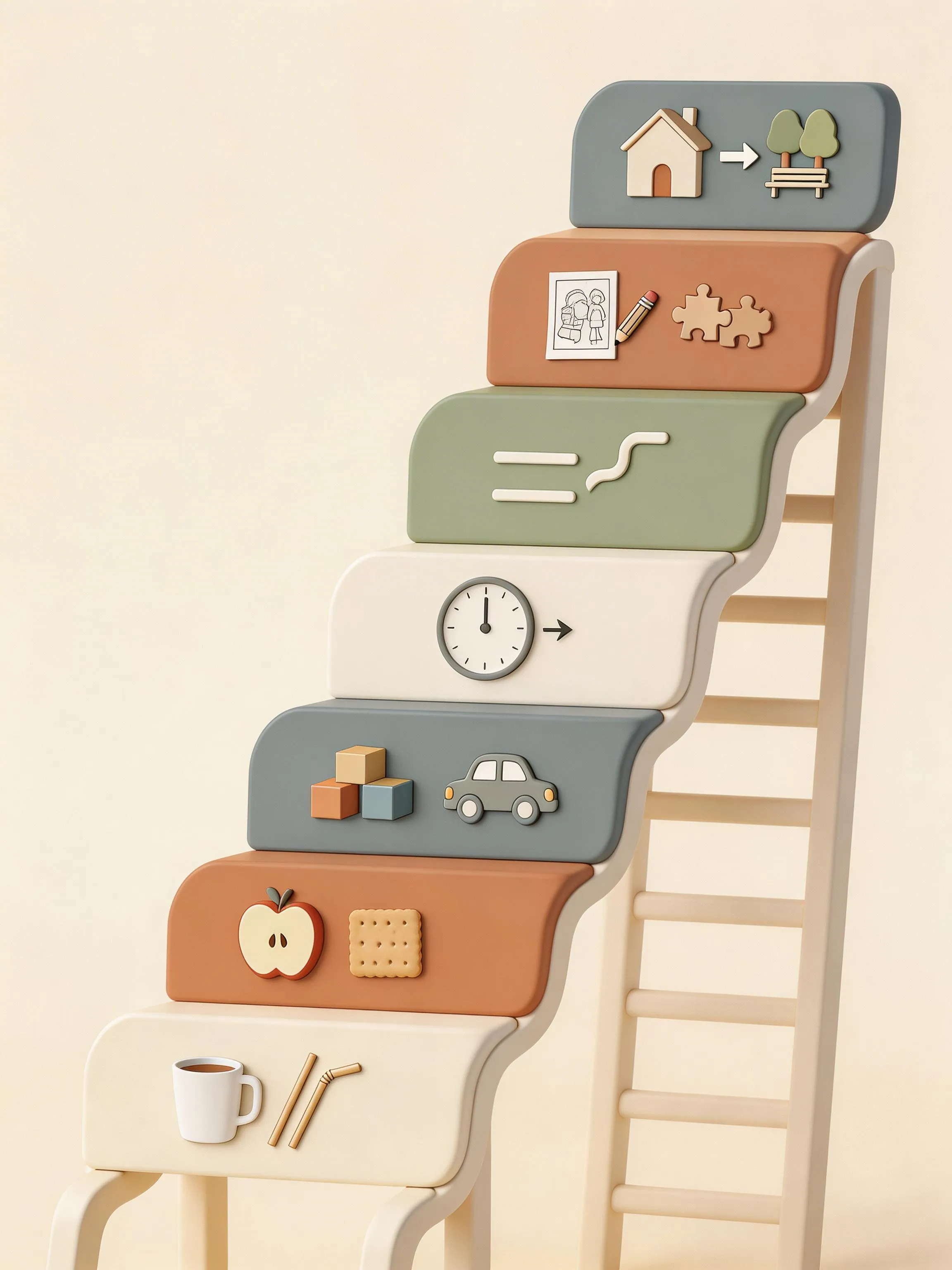
Transitions are some of the most common friction points in daily life.
Adults often experience them as sudden behavior problems:
- leaving the house
- ending screen time
- changing activities
- getting ready for bed
- moving from preferred to non-preferred tasks
But the visible behavior is usually not the whole story.
Transitions are rarely just about compliance
When a transition is hard, the missing skills may include:
- predictability
- tolerance for interruption
- communication for protest or help
- flexibility when the plan changes
- trust that something understandable is coming next
That is why commands alone often fail. The child may not only be refusing. The child may be struggling with the whole shift process.
Many transition problems are really combinations of smaller problems:
- stopping something preferred
- tolerating uncertainty
- moving toward something less interesting
- losing a predictable sequence
- not having a clear way to say
help,wait, orfinished
If adults treat all of that as simple noncompliance, the support plan becomes too blunt.
Routines are useful until they become brittle
Routines reduce uncertainty. That can be helpful.
The problem starts when routines become so rigid that any change feels like collapse. A child who can only succeed under one exact sequence has not yet built enough flexibility for ordinary life.
The goal is not to destroy routines. The goal is to use routines as scaffolding while gradually building tolerance for small changes.
Adults often make transitions harder
Common mistakes include:
- changing demands too abruptly
- offering no warning at all
- using too much language in a stressed moment
- prompting after distress has already escalated
- expecting flexibility without teaching it
These mistakes are understandable. They are also common reasons transitions stay hard.
Adults also tend to start at the hardest transition:
- leaving the favorite activity
- ending screen time
- bedtime after a long day
- leaving the park
That is usually too big a starting point. Teaching flexibility only at peak difficulty often teaches fear, not coping.
What usually helps
Good transition support often includes:
- simple previewing
- clearer first-then structure
- useful communication options like
help,wait, orfinished - small, teachable flexibility steps
- realistic expectations for processing time
The point is not to make every transition frictionless. The point is to make them more learnable and less chaotic.
Ask what part of the transition is actually hard
Different transition problems need different supports.
The hard part may be:
- stopping a preferred activity
- leaving a preferred space
- starting a non-preferred task
- uncertainty about what comes next
- speed because the adult is moving too fast
- communication because the child cannot protest, negotiate, or ask for help clearly enough
This question matters because “transitions are hard” is too vague to guide teaching. Two children may both melt down during transitions for very different reasons.
Use routines as scaffolding, not traps
A good routine gives the child enough predictability to feel safe without requiring the exact same sequence forever.
That often means:
- keeping the broad structure stable
- using clear visual or verbal anchors
- changing one small detail at a time
- previewing when a bigger change will happen
If you want the fuller step-by-step version of that approach, read How to Build Flexibility Without Making Life More Chaotic.
Communication changes transitions more than adults expect
Some transition plans are too focused on warnings and visuals while ignoring communication.
If a child can say or signal:
- help
- wait
- finished
- one more minute
- break
- different
the whole shift process often becomes easier.
That is because transitions are not only timing problems. They are negotiation problems, loss problems, and uncertainty problems. Communication helps with all three.
What to do in the moment
When a transition is already going badly, the goal is not to win an argument.
It is to reduce confusion and get the situation back to something the child can process.
In the moment, that often means:
- using fewer words, not more
- showing the next step visually if possible
- offering one clear support option
- avoiding stacked demands
- moving from argument into structure
What usually does not help is rapid talking, repeated commands, or adding new expectations after distress has already escalated.
Build flexibility gradually
Flexibility usually grows from smaller changes to bigger ones:
- one small variation in a familiar routine
- one delayed preferred item
- one different order of events
- one slightly changed transition cue
That is often more effective than suddenly demanding full adaptability.
Signs the plan is working
Progress in transitions is rarely all-or-nothing.
Look for:
- shorter recovery after a hard shift
- fewer transition points that collapse completely
- more successful movement with the same cue
- the child using communication before escalation
- tolerance for one small change inside a familiar routine
Those are meaningful signs of growth even if some bigger transitions are still hard.
Printable transition plan
Use one copy for one recurring transition. The plan should make the cue, communication, and end visible rather than relying on repeated adult directions.
Transition: from __________________ to __________________
Why it matters: ______________________________________
The hardest part appears to be:
- stopping the current activity
- uncertainty about what comes next
- sensory change between places
- starting the next task
- speed or insufficient processing time
- no reliable way to ask, protest, or negotiate
- another barrier: __________________________________
Natural cue: _________________________________________
Preview or visual: ___________________________________
Available messages:
- help
- wait
- more time
- finished
- break
- what changed?
- different option
What the adult will do after each message: ___________
The first observable transition step: _______________
How finished/arrival is shown: _______________________
Regulation or access support that stays: ____________
Adult prompt to fade first: __________________________
What counts as progress this week: ___________________
Practice the plan below the breaking point
Run the first practices during a lower-stakes transition. Keep the broad routine stable and change only one difficulty feature: duration, preferred activity, location, person, or predictability. Do not lengthen the transition and remove support at the same time.
Visual supports are included in an evidence-based-practice brief from the National Professional Development Center/AFIRM team (ERIC record). Use the free visual schedule template to create a first-then sequence or change card, then use the schedule-teaching guide to fade adult prompts.
Four-practice review
| Practice | Transition step completed | Communication used | Least support | Barrier or change for next time |
|---|---|---|---|---|
| 1 | ||||
| 2 | ||||
| 3 | ||||
| 4 |
If distress becomes more intense, more frequent, or linked to pain, illness, sleep, medication, trauma, or safety risk, pause the teaching experiment and seek individualized help. A transition plan should reduce uncertainty; it should not become forced exposure to an inaccessible situation.
Read next
Print the free autism visual schedule template for a first-then board, short routine, change card, and support options.
If home carryover itself is breaking down, read Autism Home Practice Without Burnout.
If the bigger issue is teaching flexibility inside routines, read How to Build Flexibility Without Making Life More Chaotic.
If you want the broader framework for routines, behavior, and real-life participation, see the book.
For a comprehensive guide to meltdowns, transitions, and building flexibility, see Autism Meltdowns and Transitions: A Practical Guide.