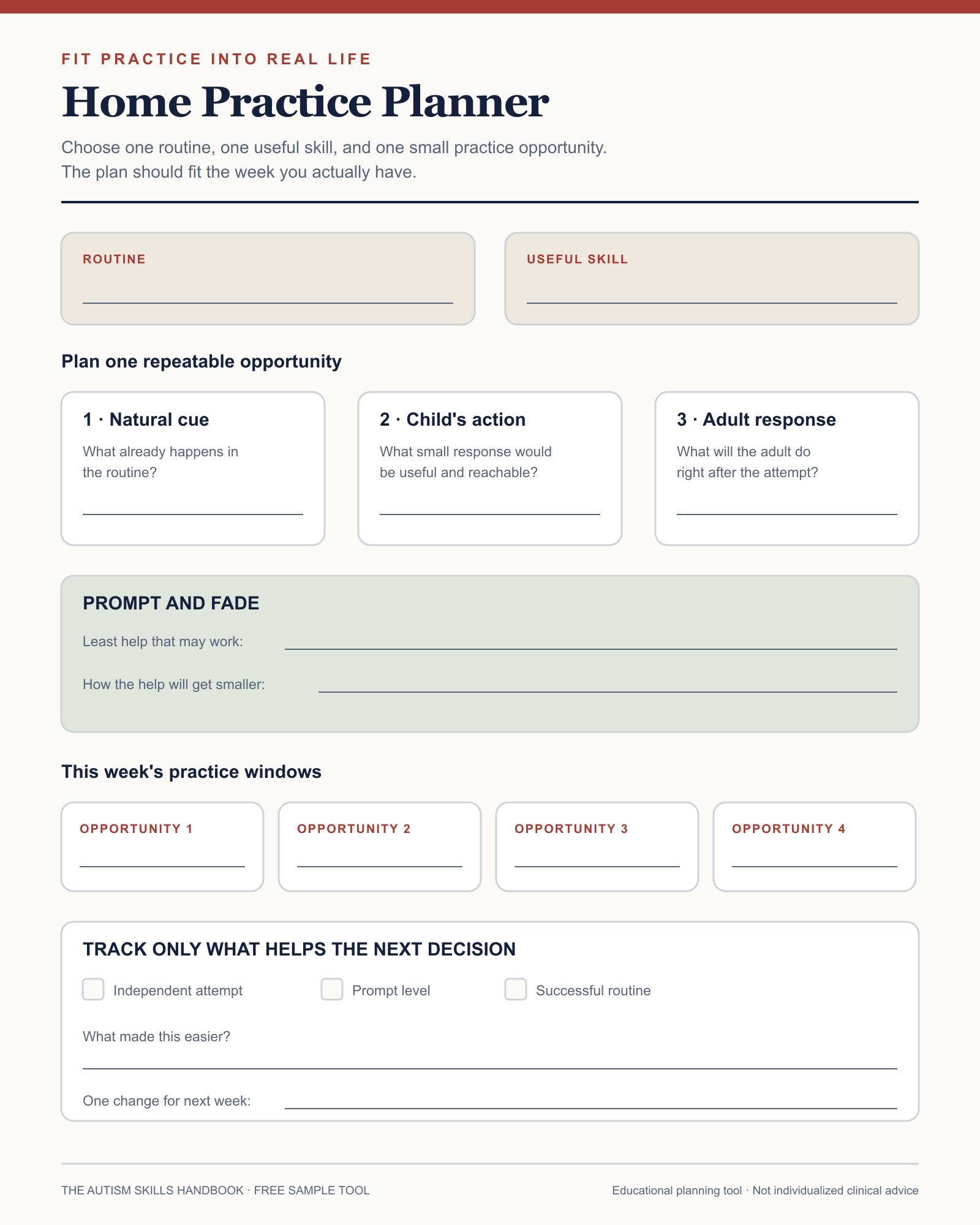

Meltdowns are the most visible and most misunderstood part of autism for many families. They happen in public, they exhaust everyone involved, and the advice parents receive — “stay calm,” “be consistent,” “use consequences” — rarely addresses why meltdowns happen in the first place.
This guide covers the actual mechanics of meltdowns, the critical difference between meltdowns and tantrums, practical strategies for reducing transition friction, and what to do when a meltdown is already happening.
Why transitions are hard
Transitions require a cluster of skills working together: predicting what comes next, letting go of the current activity, tolerating the brief uncertainty of the in-between moment, shifting attention to something new, and regulating the emotional response to all of this.
For autistic children, one or more of these component skills may be weaker than expected. The result is not a “behavior problem” — it is a skill gap under pressure.
Missing skills that drive transition difficulty:
- Weak prediction. If the child does not know what is coming next, every transition is a leap into the unknown. Uncertainty triggers the stress response.
- Limited communication. If the child cannot say “I’m not done” or “I need more time” or “I don’t want to do that,” the only available responses are behavioral — refusal, escalation, shutdown.
- Low flexibility. Some children develop strong routines partly because routines reduce unpredictability. When the routine is interrupted, the coping strategy is gone.
- Sensory factors. Moving between environments often means moving between sensory profiles. A quiet room to a loud cafeteria. A dim space to bright fluorescent lighting. Each transition layer adds load.
What a meltdown actually is
A meltdown is not a choice, a manipulation, or a tantrum that escalated. It is a neurological event — the child’s regulatory system has been overwhelmed and is no longer capable of organized response.
Meltdown vs. tantrum
This distinction matters because the appropriate response is completely different.
A tantrum is goal-directed behavior. The child wants something — attention, an object, escape from a demand — and is using escalation to get it. Tantrums have an audience awareness. The child may check to see if you are watching. They may escalate when attention is given and stop when the goal is achieved or the audience leaves.
A meltdown is a loss of regulation. The child’s nervous system is overwhelmed and they cannot stop. There is no audience awareness. The child does not respond to negotiation, consequences, or removal of the audience. A meltdown continues until the child’s system exhausts itself and begins to recover.
The practical difference: tantrums can be shaped by how adults respond. Meltdowns cannot. They can only be waited out safely and, over time, prevented by addressing the underlying skill gaps and environmental triggers.
Practical transition strategies
Visual cues and advance warnings
Visual cues are the single most effective transition tool for most autistic children. A picture schedule, a timer, a “first-then” board — these make the invisible visible.
- Show what comes next. Before announcing a transition, show the child what they are transitioning to. “First we clean up, then we go outside” with picture support.
- Give time warnings. “Two more minutes, then we clean up.” Use a visual timer so the child can see time passing rather than relying on an abstract concept.
- Use a consistent transition cue. A specific phrase, sound, or visual signal that always means “we are about to change activities.” Consistency makes the cue predictable.
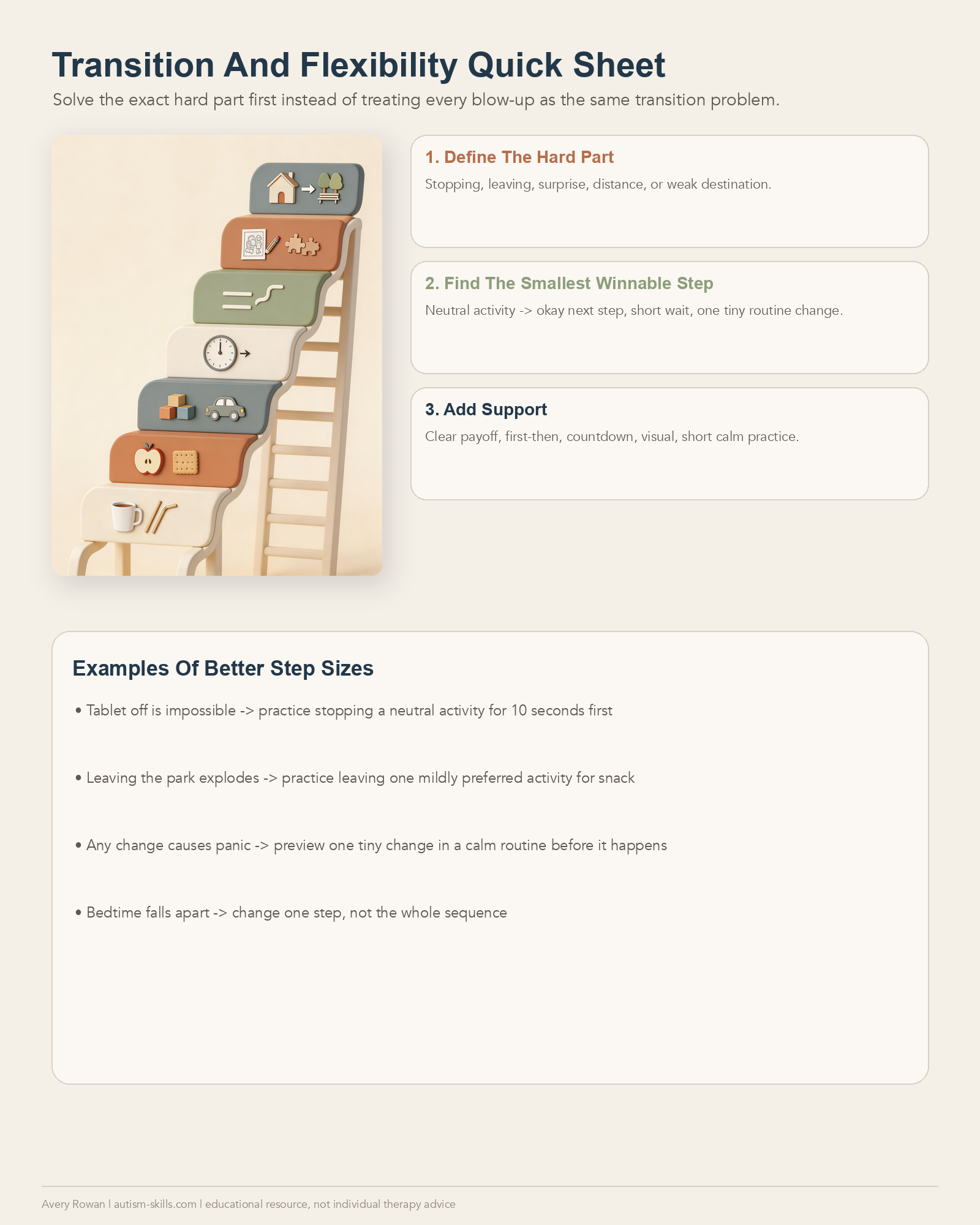
The flexibility ladder
Building transition tolerance works the same way as building any other skill — in small, graduated steps.
Start with transitions the child can already handle (moving toward a preferred activity) and gradually introduce harder transitions:
Level 1: Preferred activity to preferred activity (easy transition) Level 2: Preferred activity to neutral activity Level 3: Neutral activity to neutral activity Level 4: Preferred activity to less preferred activity (hardest)
At each level, use supports (visual cues, advance warnings, brief waiting), and only move to the next level when the current one is consistent.
Download the Transition and Flexibility Quick Sheet for a printable ladder-based planning tool.
Start with the transition, not the demand
A common mistake is to announce both the transition and the demand simultaneously: “Stop playing. We need to clean up and get ready for dinner and set the table and wash your hands.” That is four demands disguised as one transition.
Separate the transition from the demand. First, transition. Then, once the child is settled in the new context, introduce the next expectation.
What to do during a meltdown
When a meltdown is already happening, the goal shifts from teaching to safety and recovery. This is not a teaching moment.
During the meltdown:
- Ensure safety. Move objects that could cause harm. Position yourself to prevent the child from running into danger. Do not restrain unless absolutely necessary for safety.
- Reduce sensory input. Lower lights if possible. Reduce noise. Remove yourself from the audience if that helps (some children recover faster without an adult hovering). Others need a calm adult presence nearby.
- Do not talk much. Verbal input during a meltdown adds load to an already overwhelmed system. Short, quiet phrases only: “I’m here. You’re safe.”
- Do not negotiate or teach. “If you calm down, you can have…” does not work during a meltdown because the child’s cognitive processing is offline. Save teaching for when the child is regulated.
- Wait. This is the hardest part. Meltdowns run their course. The child’s system will come down, but it takes time.
After the meltdown:
- Allow recovery time. The child is not fine the moment the meltdown ends. There is an exhaustion period. Do not immediately reintroduce the demand that triggered it.
- Reconnect. A brief, calm reconnection — a quiet word, a gentle touch, sitting nearby — signals that the relationship is intact.
- Analyze later. When everyone is calm, think about what happened. What was the trigger? What skill gap was exposed? What could be different next time? This is when learning happens — for the adults.
Long-term prevention
The most effective meltdown reduction strategy is not a meltdown intervention. It is building the skills that prevent the overload in the first place.
- Build communication. A child who can say “stop,” “help,” “wait,” or “I need a break” has alternatives to escalation. Functional communication is the single highest-leverage meltdown prevention tool.
- Reduce the demand-skill gap. If transitions reliably trigger meltdowns, the child needs better transition skills — not better consequences for melting down.
- Teach flexibility as a skill. Flexibility is not a personality trait. It is a learnable skill that develops with practice, starting from small, low-stakes changes in calm conditions.
- Monitor cumulative load. Many meltdowns are not about the triggering event. They are about everything that happened before it. A child who has been holding it together all day at school may melt down at home over something minor — because the minor thing was the last straw.
For more on building flexibility systematically, read How to Build Flexibility Without Chaos.
How the handbook covers transitions and meltdowns
Chapters 18 and 19 of the Autism Skills Handbook cover transitions, routines, and flexibility as teachable skill systems — not as behavior management problems. The chapters provide specific protocols for building transition tolerance, creating visual supports, and designing flexibility practice that does not destabilize the child’s routine.
The Transition and Flexibility Quick Sheet gives you a printable ladder-based planning tool. The Home Practice Planner helps you embed transition practice into daily routines without creating a separate training session.