
There comes a point in every family’s journey where the question shifts. It stops being “what therapy should we add?” and becomes “where are we going with all of this?”
That is a good question. Most families never get permission to ask it. The system pushes toward more: more hours, more specialists, more programs, more goals. Stopping or reducing feels like giving up. And nobody wants to be the parent who gave up.
But the goal of intervention was never endless therapy. It was building skills that change what becomes possible next. Making the child more able to learn from daily life, school, peers, and community — not more dependent on the therapy room.
What a good trajectory looks like
After effective intervention, the child should be more able to:
- benefit from family routines without constant adult direction
- participate in classroom instruction without one-to-one support for every task
- learn from peers by watching, not only from adults by prompting
- manage basic daily demands with less scaffolding
- communicate needs reliably enough that daily life runs more smoothly
These are not therapy outcomes. They are life outcomes. The therapy was the vehicle, not the destination.
If a child has been in intensive services for years and daily life has not meaningfully changed, the problem is not usually the child. It is the plan, the targets, the intensity model, or the service quality.
When therapy shopping replaces planning
Therapy shopping is the pattern of adding, switching, and accumulating services without a coherent trajectory. It looks like:
- Starting a new therapy every six months because the last one “wasn’t working”
- Adding speech, OT, ABA, social skills, feeding therapy, and tutoring without shared priorities
- Feeling like progress is always around the corner if the family just finds the right provider
- Each new professional adding their own goals without anyone removing old ones
- The child’s schedule is full but the parents cannot explain what the shared plan is
This pattern is understandable. Families are scared. Progress feels slow. And the system rewards activity — more appointments feel more productive than fewer appointments that are better designed.
But activity is not direction. Buying hours without buying clarity is one of the most expensive mistakes in autism support.
The questions that redirect
When the trajectory feels unclear, these questions can pull it back into focus:
What should life look like in two years? Not in therapy terms. In life terms. What daily routine should be smoother? What should the child be able to do at school? What community activities should be possible? What level of independence is realistic?
Which skills would open the most doors? Some goals have outsized future value because they make many later goals easier. Asking for help. Reporting pain. Tolerating schedule changes. Waiting safely. Following a simple schedule. Using communication to solve problems before behavior does.
Is the child learning from life, or only from therapy? If progress only happens inside the therapy room and nothing changes outside it, the plan may be building therapy performance without building real skills.
What would make us ready to reduce hours? If nobody can answer this, the plan may not have a trajectory — just an intensity level.
Independence is not one thing
A common fear is that the child will never be independent. But independence is not a single finish line. It has domains:
- Communication and self-advocacy. Can the child express needs, report problems, ask for help?
- Daily living and health. Can the child manage basic self-care, hygiene, meals, and health awareness?
- School or work participation. Can the child function in a structured group setting with appropriate support?
- Community access. Can the child navigate a store, use transportation, order food, visit a library?
- Leisure and relationships. Can the child enjoy activities, spend time with others, participate in family routines?
- Safety and decision-making. Can the child recognize danger, protect privacy, make basic choices?
A person can be strong in some domains and weak in others. Goals should be chosen by domain, not by fantasy of total independence or fear of total dependence.
Adolescence changes everything
Early intervention focuses on engagement, communication, imitation, and foundational learning. Those are the right priorities for young children.
But adolescence adds new needs that many programs ignore:
- Privacy and body safety
- Emotional self-management
- Self-advocacy
- Age-appropriate leisure
- Flexible group participation
- Practical independence (hygiene, meals, navigation)
A team that keeps teaching preschool-style goals to a teenager is behind. The child’s needs have changed. The plan should change with them.
When to reduce, change, or stop services
Services should be reconsidered when:
- The same broad goals have been in place for over a year without meaningful change
- The child performs well in therapy but daily life has not improved
- The team cannot explain what greater independence would look like next year
- The family is spending on services out of habit or fear rather than clear purpose
- The child’s needs have shifted but the program has not
Reducing services is not giving up. It is making room for the child to practice skills in real life — which is where they ultimately have to work.
The right question
The right question is not “how much therapy should my child have?” It is “what does my child need to learn next, and what is the best way to teach it?”
Sometimes the answer is intensive one-on-one support. Sometimes it is a structured classroom. Sometimes it is coached home routines. Sometimes it is community practice with adult support. Sometimes it is less intervention and more real life.
The answer should change as the child changes. Any plan that stays the same year after year is not a plan. It is a habit.
Read next
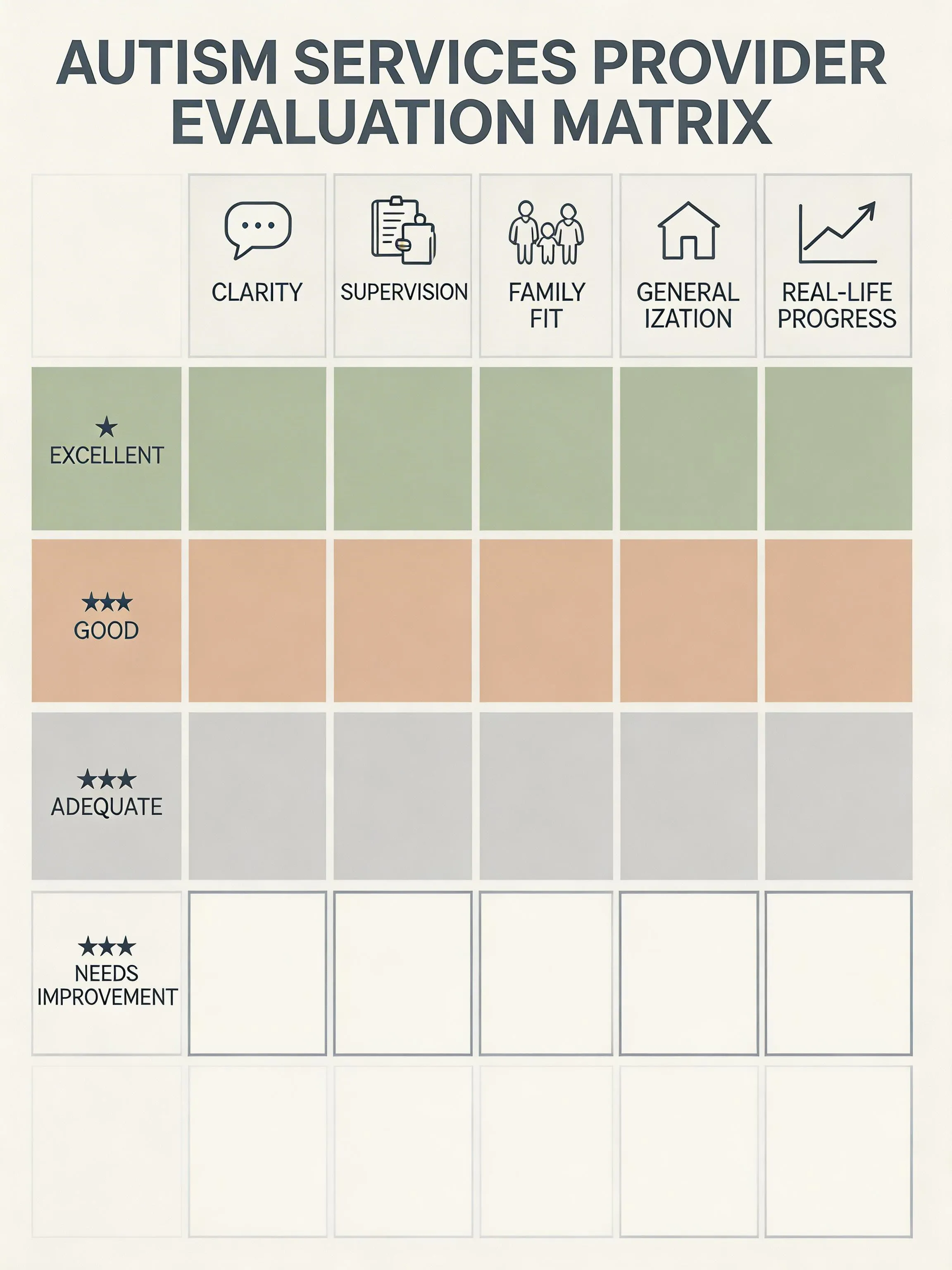
If you need help evaluating whether current services are high-quality, read Questions to Ask Before Paying for More Autism Hours.
If the team needs better coordination, read How to Build a Good Autism Support Team.
For the complete long-term planning framework and adolescent transition guide, see the book.