
Many families first experience autism as confusion, not clarity. A child may know letters but struggle to join play. Another child may have words but still not ask for help. A child may follow one familiar routine well and still fall apart when anything shifts.
That is why broad labels are not enough. They do not tell you what the child can use in daily life, what skill is missing underneath the visible struggle, or what should be taught first.
Autism is often uneven, not global
One of the most useful shifts families and professionals can make is to stop thinking in terms of a single overall delay.
Autism often changes development unevenly:
- communication may be weaker than vocabulary suggests
- play may be narrower than intelligence suggests
- flexibility may be weaker than memory suggests
- participation may break down when routines change
- independence may lag far behind isolated academic skills
This is one reason autism can be misread. A child may look strong in one slice of development and still be missing foundations that affect daily life everywhere else.
The better question is: what changes ordinary life?
Instead of asking only whether a child has speech, eye contact, or a diagnosis, ask what is getting in the way of everyday life right now.
For example:
- Can the child get another person’s attention in a useful way?
- Can the child ask for help, refuse, wait, and transition?
- Can the child stay with a shared activity long enough to learn?
- Can the child learn from another person, not only from repetition?
- Can the child participate with less adult rescue?
These questions are more actionable than generic trait lists because they point toward missing skills, not just descriptions.
Use a daily-life lens, not a slogan lens
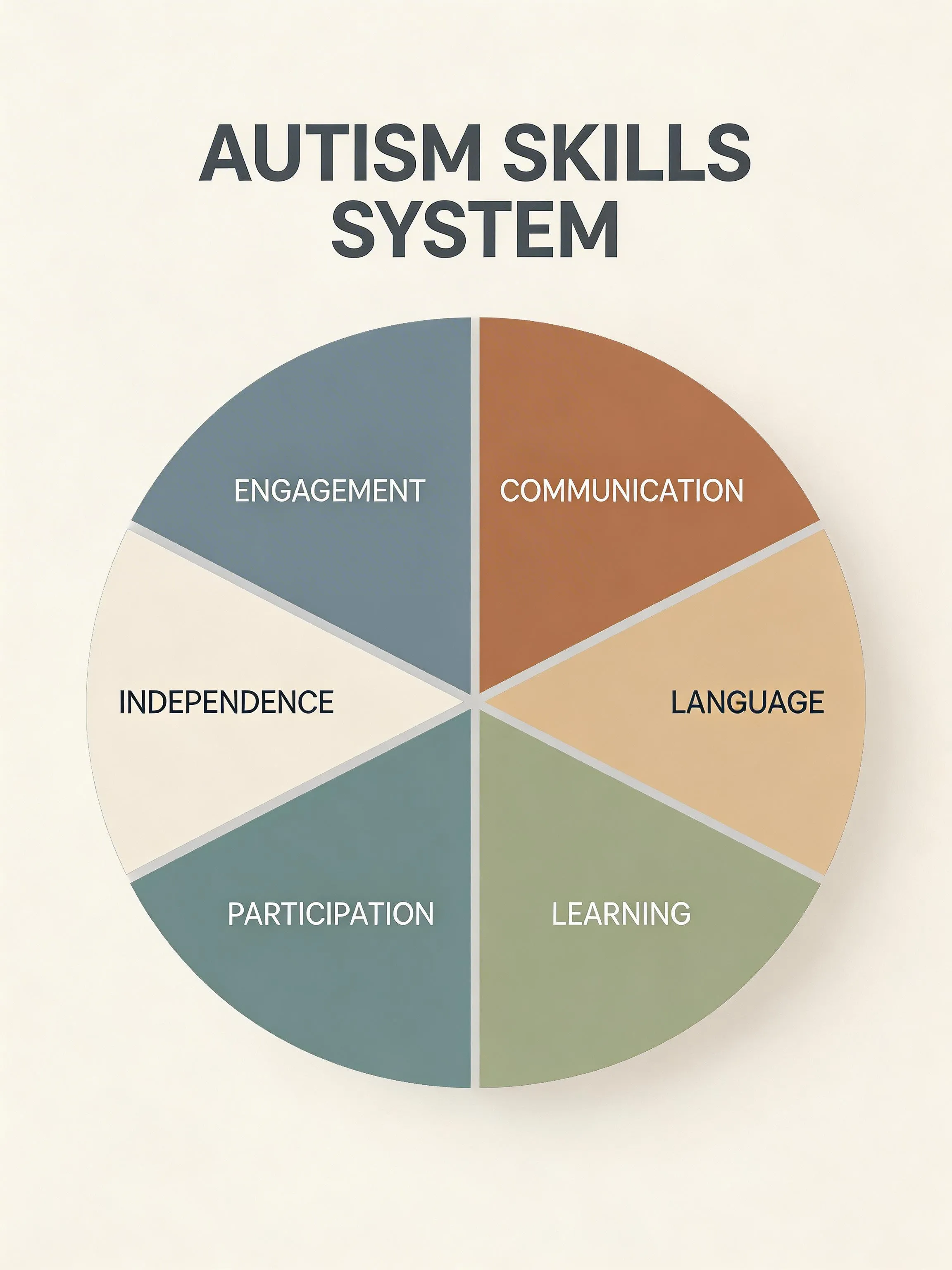
The framework behind The Autism Skills Handbook organizes development into six connected domains:
- Engagement
- Communication
- Language
- Learning
- Participation
- Independence
Those domains overlap, but they make day-to-day problems easier to interpret.
If a child melts down during transitions, the issue may not simply be “behavior.” It may involve flexibility, predictability, communication, and regulation. If a child labels flashcards but cannot ask for help, the gap is not just vocabulary. It is functional communication.
Why this matters for teaching
Adults often chase visible goals too early:
- sitting before engagement
- worksheets before group readiness
- labels before useful requests
- speech polish before communication access
- compliance before initiative
That order creates fragile progress. The child may appear successful in narrow teaching moments while daily life stays hard.
A stronger approach is to ask:
- What is the highest-leverage missing skill here?
- What would make daily life easier this week?
- What foundation would make other goals easier later?
That is the difference between random effort and coherent progress.
What to do next
If the picture still feels blurry, do not try to solve everything at once. Start by identifying the live problem that shows up most often across routines. Then work backward to the likely missing skill underneath it.
If your main concern is early red flags and next steps, read Early Signs of Autism and What to Do Next.
If your main concern is choosing the right targets, read How to Choose Autism Goals That Matter.
If you want the full framework in one place, the complete system lives in the book.