Most home practice plans fail within two weeks. Not because parents lack motivation, but because the plans are designed for a therapy room — structured sessions, specific materials, careful timing — and then handed to families who are already running on empty.
This guide covers how to build home practice that actually survives contact with your real life, using micro-routines instead of formal sessions.
Why home practice plans keep failing
The standard model goes like this: the therapist sends home a list of activities. The parent tries to carve out time for practice. The first few days go reasonably well. By day four, something breaks — a bad night, a sibling crisis, a schedule change — and practice stops. By the next therapy session, the parent feels guilty and the therapist is confused about why “carryover” is not happening.
The problem is not parent effort. It is plan design.
The overload trap: Most home practice programs ask too much. Five goals, three times each, with data collection. That is a part-time job layered on top of an already demanding full-time one. Parents do not need a comprehensive home therapy program. They need one or two things they can actually do.
Home is not a clinic: The therapy room is designed for structured practice — controlled materials, consistent reinforcement, minimal distractions. Home has siblings, pets, cooking, laundry, emotions, and exhaustion. Any home practice plan that does not account for this reality is a plan that will collapse.
The burnout cycle: When practice fails, parents blame themselves. Guilt reduces engagement. The therapist adds more instructions. The gap between the plan and reality grows. Eventually, “home practice” becomes a source of stress rather than support.
Micro-routines: the practice model that works
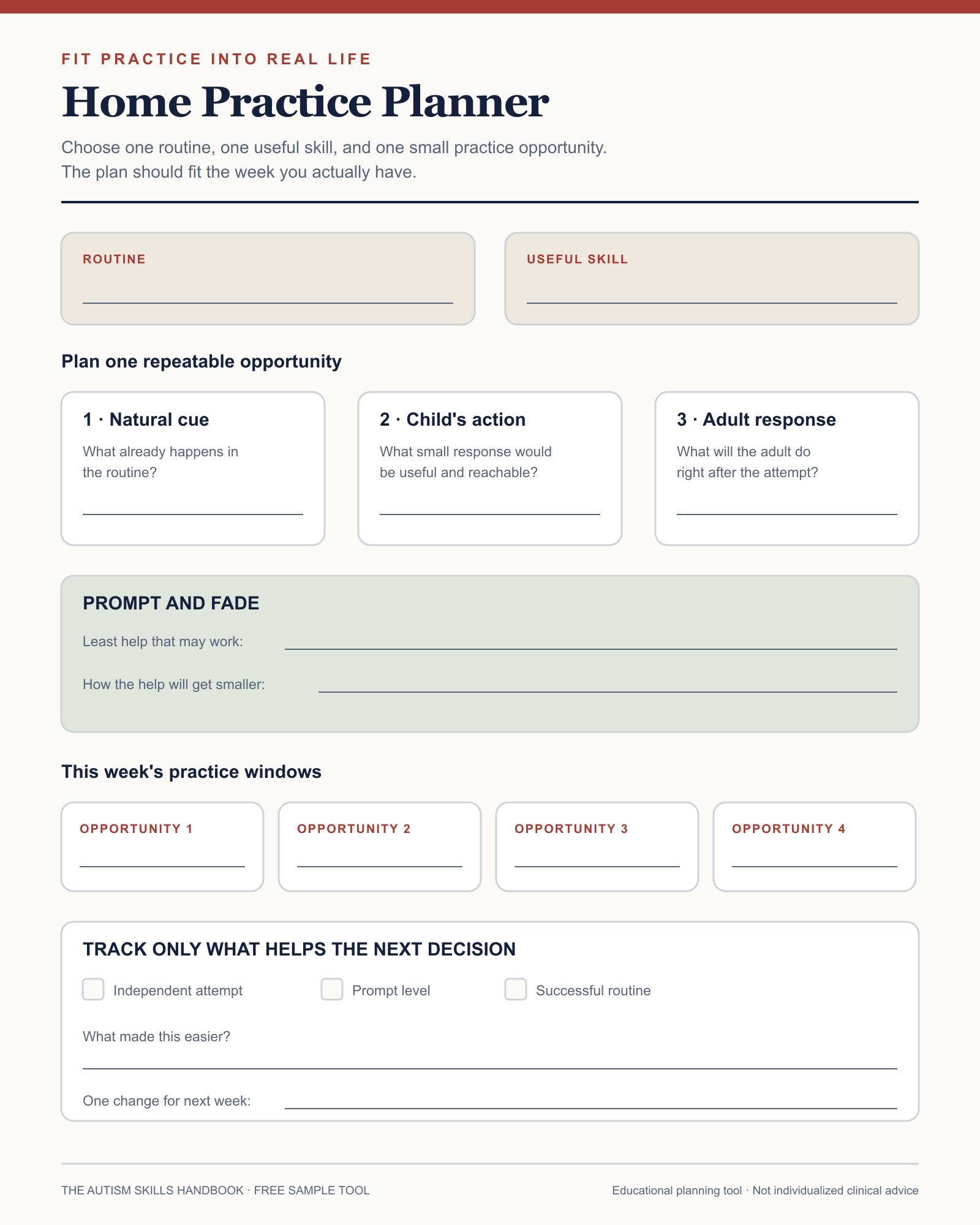
A micro-routine is a single skill practice opportunity attached to an existing daily routine. It is not a session. It is a moment — usually 2-5 minutes — that happens naturally because it is built into something you already do.
The structure is simple:
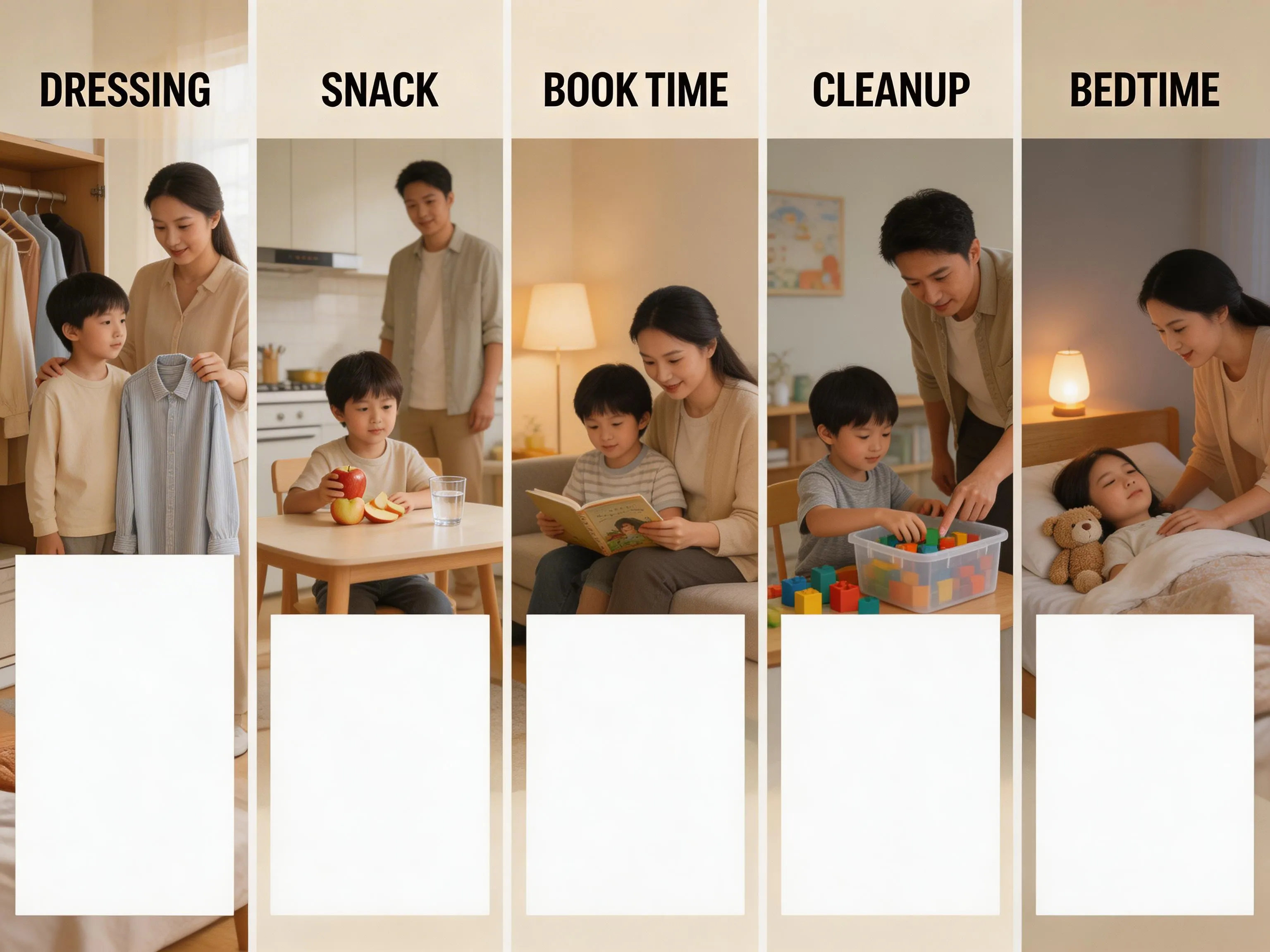
- Pick one routine that already happens every day (meals, getting dressed, bath, bedtime, going outside)
- Pick one skill to practice during that routine
- Create one consistent opportunity within the routine
- Respond the same way every time
Example micro-routines:
| Routine | Skill | Opportunity |
|---|---|---|
| Breakfast | Requesting | Hold up two cereal options. Wait for the child to indicate a preference before pouring. |
| Getting dressed | Choice-making | Offer two shirt options. Let the child point, reach, or vocalize to choose. |
| Going outside | Asking for help | Put shoes in sight but slightly out of reach. Wait for the child to signal before helping. |
| Bath time | Following a sequence | Use a visual schedule of 3 bath steps. Point to each step before doing it. |
| Bedtime | Commenting | Look at one page of a book together. Model one comment: “Big dog!” and pause. |
Each micro-routine adds less than 3 minutes to the existing routine. But because it happens every day, in a natural context, with consistent adult responding, it produces meaningful skill development over time.
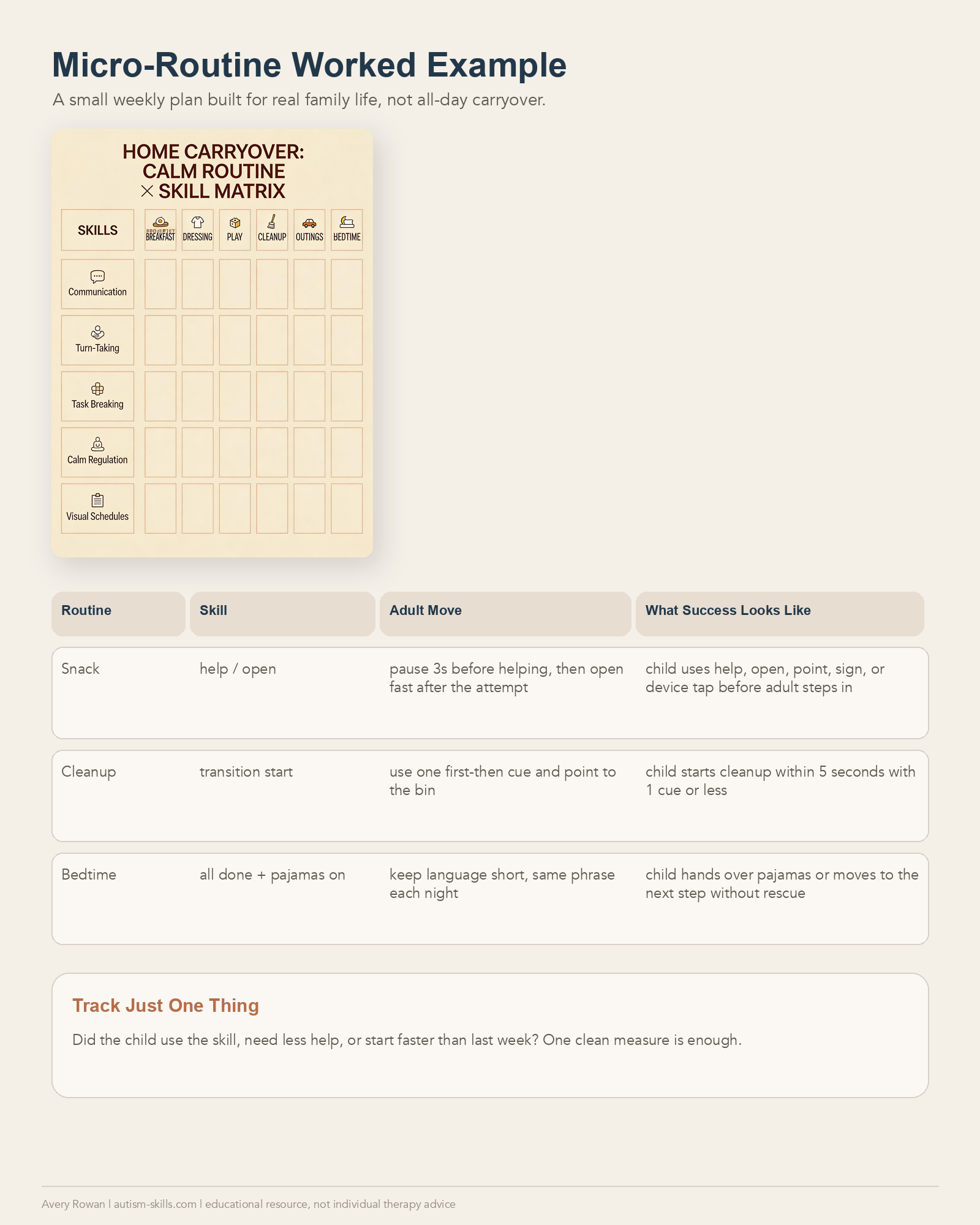
For a ready-to-use planning tool, download the free Home Practice Planner. The Micro-Routine Worked Example shows a complete week-level plan for one family.
Activities organized by skill area
Not every activity needs to target a specific therapy goal. But if you want to be intentional about building skills at home, here are practical activities organized by the areas that matter most.
Communication activities
- Requesting practice during meals. Hold preferred foods visible but wait for a signal before giving.
- Choice boards at play time. Offer 2-3 activity options with pictures. Let the child select.
- Narrating daily routines. Describe what you are doing in simple language: “Shoes on. Now outside.”
- Pause-and-wait during songs or games. Start a favorite routine and stop mid-way. Wait for the child to signal “more.”
Independence activities
- Self-help during dressing. Start the process (pull shirt over head) and let the child finish (pull it down).
- Tidying up one thing. After a snack, the child carries their plate to the counter. One step. Every time.
- Simple household participation. Carrying items, wiping a surface, putting clothes in a hamper.
- Gradual reduction of help. Identify one task where you help fully. Reduce your help by one step this week.
Flexibility activities
- Small routine changes. Sit in a different chair. Take a different path to the car. Use a different cup.
- Waiting practice. Start with 5 seconds of waiting for a preferred item. Build tolerance gradually.
- Offering unexpected options. “Today we’re going to the park instead of the playground.” Start with positive surprises before introducing less preferred changes.
For a deeper look at the transition and flexibility strategies, read Transitions and Routines in Autism.
Tracking progress without burnout
Formal data collection belongs in therapy sessions, not at the dinner table. But you still need a way to know whether things are working.
Simple weekly tracking: At the end of each week, answer three questions:
- Did the micro-routine happen most days? (If no, the routine needs redesigning, not more effort)
- Did the child need less help this week than last week? (This is the real measure of progress)
- Did the child use the skill in a different context? (This is generalization — the ultimate goal)
If the answer to question 1 is consistently no, the problem is the plan, not the parent. Redesign the routine to be simpler, shorter, or attached to a more reliable part of the day.
If the answer to question 2 is yes over several weeks, the skill is developing — even if daily performance varies.
How the handbook supports home practice
Chapter 21 of the Autism Skills Handbook is entirely devoted to home practice — not as a supplement to therapy, but as its own system with its own design principles. The chapter covers the micro-routine model, common failure patterns, and how to align home practice with clinical goals without turning the home into a second clinic.
The Home Practice Planner provides a weekly planning template. The Autism Daily Living Skills Checklist helps you identify useful daily routines, record the current level of support, and choose one practical next step.
If home practice has been a source of stress, read Autism Home Practice Without Burnout for a focused look at why most plans fail and how to build ones that do not.