

Most parents who search for early signs of autism are not looking for a medical definition. They are looking for a way to make sense of something they have already noticed — a pattern that does not quite fit, a response that feels different, a gap that seems to be growing instead of closing.
This guide is designed to help you understand what those patterns actually mean, what the research says about early identification, and what practical steps you can take right now — whether or not a formal evaluation is on the table yet.
What early signs of autism actually look like in daily life
Early signs of autism are not usually dramatic. They tend to show up as absences — things that do not happen, or happen less often than expected — rather than as unusual behaviors that suddenly appear.
The patterns that matter most in toddlers tend to cluster around social communication:
- Reduced shared attention. The child does not reliably look where you point, or does not point to show you things. They may look at objects but rarely check in with you to share the experience.
- Limited back-and-forth. Social exchanges feel one-sided. The child may not respond to their name consistently, may not copy simple gestures like waving, or may not engage in the kind of easy turn-taking that most toddlers start to show around 12 months.
- Fewer communicative gestures. Pointing, reaching, showing, waving — these early gestures are the foundation for language. When they are absent or rare, it changes how communication develops.
- Narrow range of facial expressions during social moments. Not just smiling less, but showing less variety in emotional expression when interacting with people.
- Strong preference for objects over people. The child may study objects with sustained focus but seem less interested in faces, voices, or social play.
These signs are often clearest between 12 and 24 months, but some families notice earlier — especially when they have older children to compare against.
What makes early signs confusing is that many of them overlap with normal developmental variation. Not every late talker has autism. Not every child who lines up toys is on the spectrum. The signal is in the pattern, not in any single behavior.
Screening vs. diagnosis: what each one actually tells you
There is an important distinction that many families miss early on.
Screening is a quick check — usually a parent-completed questionnaire like the M-CHAT-R — designed to flag whether further evaluation is needed. It takes a few minutes. A positive screen does not mean your child has autism. It means the pattern of responses suggests that a closer look is warranted.
Diagnosis is a comprehensive clinical evaluation. It involves a detailed developmental history, direct observation of your child’s behavior, and standardized tools administered by a specialist — usually a developmental pediatrician, psychologist, or multidisciplinary team. Diagnosis is the process that either confirms or rules out autism, and it typically takes several hours spread across one or more appointments.
The problem most families run into is the gap between screening and diagnosis. Screening can happen at a routine pediatric visit. Diagnosis often requires a referral and a wait — sometimes several months, sometimes longer depending on where you live and what services are available.
This gap is not a reason to wait passively.
What to do while waiting for an evaluation
The single most important thing families can do during the waiting period is to stop treating it as a waiting period.
You do not need a diagnosis to begin supporting your child. Many of the foundational skills that matter most in early development — shared attention, functional communication, flexible engagement — can be supported at home through everyday interactions.
Practical steps you can take now:
- Build communication opportunities into routines. Instead of anticipating every need, create brief moments where your child has a reason to communicate — reaching, pointing, making a sound, or looking at you. Mealtimes, play, and transitions are natural contexts.
- Follow the child’s interest. If your child is drawn to specific toys or activities, join them there. Shared attention builds best when the adult enters the child’s world rather than pulling the child into a task they did not choose.
- Reduce demand and increase interaction. Early intervention is not about drilling skills. It is about increasing the quantity and quality of social engagement in ordinary moments.
- Create predictable routines. Predictability reduces anxiety and frees up cognitive resources for learning. Simple, consistent routines for meals, baths, transitions, and play give your child a framework to learn within.
These are not therapy. They are the developmental soil that therapy, when it comes, will grow in. And if the evaluation shows something other than autism, none of these steps will have done any harm. They support development regardless of diagnosis.
For a structured approach to these first decisions, the Early Signs and What to Do Next article covers the practical logic in more detail.
What not to prioritize early on
When parents first begin researching autism, the sheer volume of advice can push them toward targets that feel productive but do not actually change daily life.
Common early targets that tend to be low-leverage:
- Forcing eye contact. Eye contact is a social signal, not a prerequisite for learning. Demanding it often creates avoidance rather than connection. The goal is shared attention — and that can happen with or without direct eye gaze.
- Drilling labels and flashcards. Naming objects is a visible, testable skill, which makes it attractive for early goals. But labeling is not the same as communication. A child who can name 50 pictures but cannot ask for help, refuse something, or get your attention has a naming skill, not a communication system.
- Chasing milestones on a chart. Developmental checklists are useful for screening, but they are a poor guide for intervention. The question is not “which milestones is my child missing?” but “what skills would reduce the most friction and open the most doors?”
The framework that matters early on is not about catching up to a typical timeline. It is about identifying what skills would make the biggest difference in your child’s daily life — and starting there.
This is the core logic behind the choosing goals that matter approach in the handbook: prioritize skills that reduce friction and create momentum, not skills that simply fill a checklist.
When urgency is real
Not all developmental variation requires urgent action, but some patterns do call for prompt evaluation:
- Loss of previously acquired skills. If your child was using words, gestures, or social behaviors and has stopped, this is a regression pattern that warrants immediate evaluation — not watchful waiting.
- No communicative gestures by 12 months. No waving, pointing, reaching to be picked up, or showing objects.
- No words or word approximations by 16 months. Especially when combined with limited gesture use.
- No two-word spontaneous phrases by 24 months. Not echoed or scripted phrases, but genuinely spontaneous combinations.
- Any loss of social engagement at any age. Withdrawal from interaction, reduced responsiveness to people, or increasing preference for being alone.
If any of these are present, do not wait for the next well-child visit. Request a developmental evaluation directly. Early identification consistently predicts better outcomes — not because early therapy is magic, but because early support builds foundational skills during the period when the brain is most receptive to learning them.
How the handbook helps with early decisions
The Autism Skills Handbook dedicates its opening chapters to the exact problem most families face first: making sense of uneven development and deciding what to prioritize before being buried in conflicting advice.
Chapter 1 lays out what autism actually changes in everyday development — not as a list of deficits, but as a pattern that reshapes how learning, communication, and daily routines work. Chapter 2 provides a structured early-decisions framework that helps families choose practical next steps based on the child’s current profile rather than a generic milestone chart.
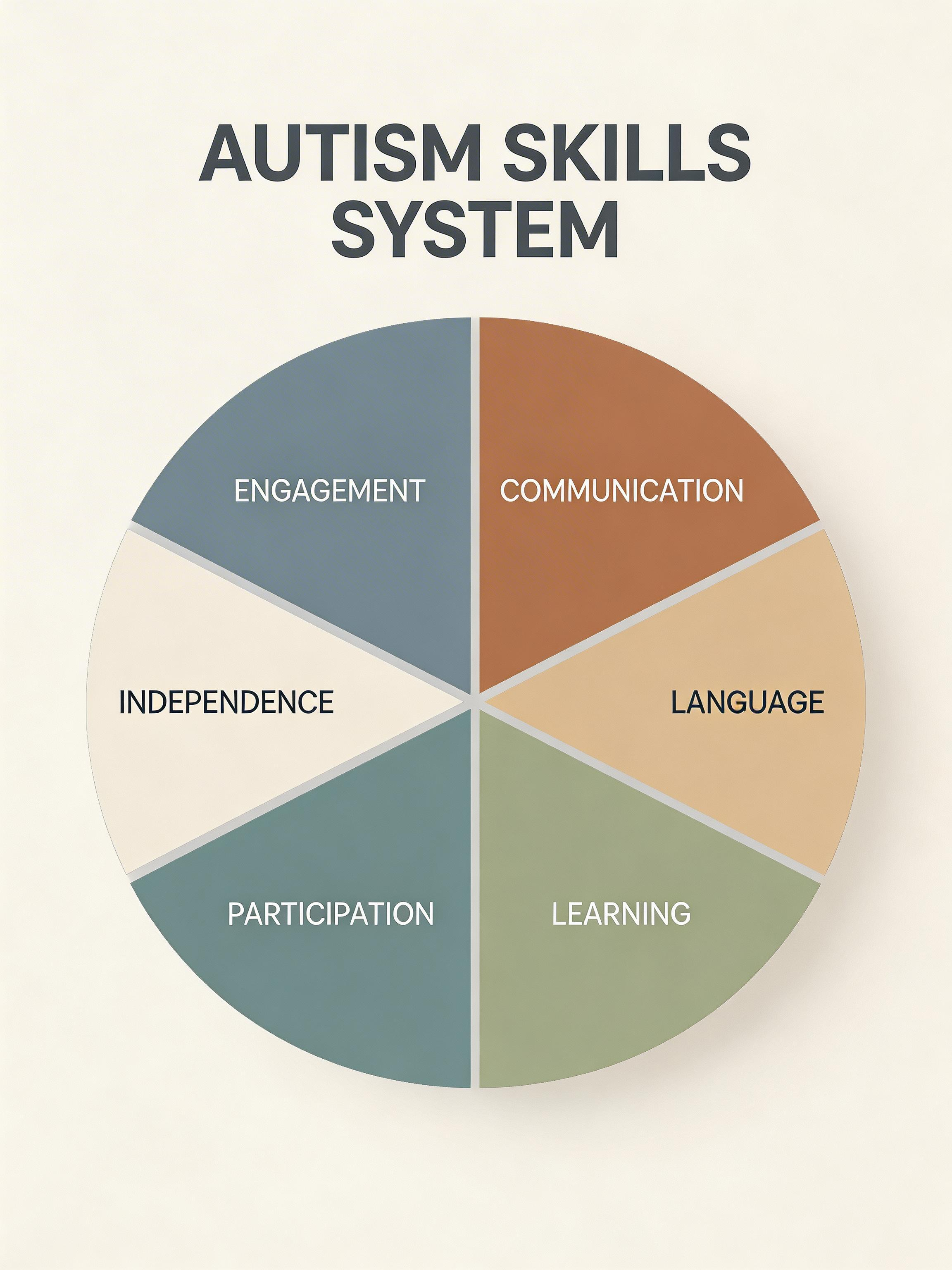
The Autism Skills System Quick Map gives you a one-page view of the six developmental domains the book organizes around, so you can see where your child’s needs fit within the broader system.
If you are in the early stages of figuring out what is happening and what to do about it, What Autism Changes in Daily Development provides a deeper look at the developmental logic that shapes everything else.