
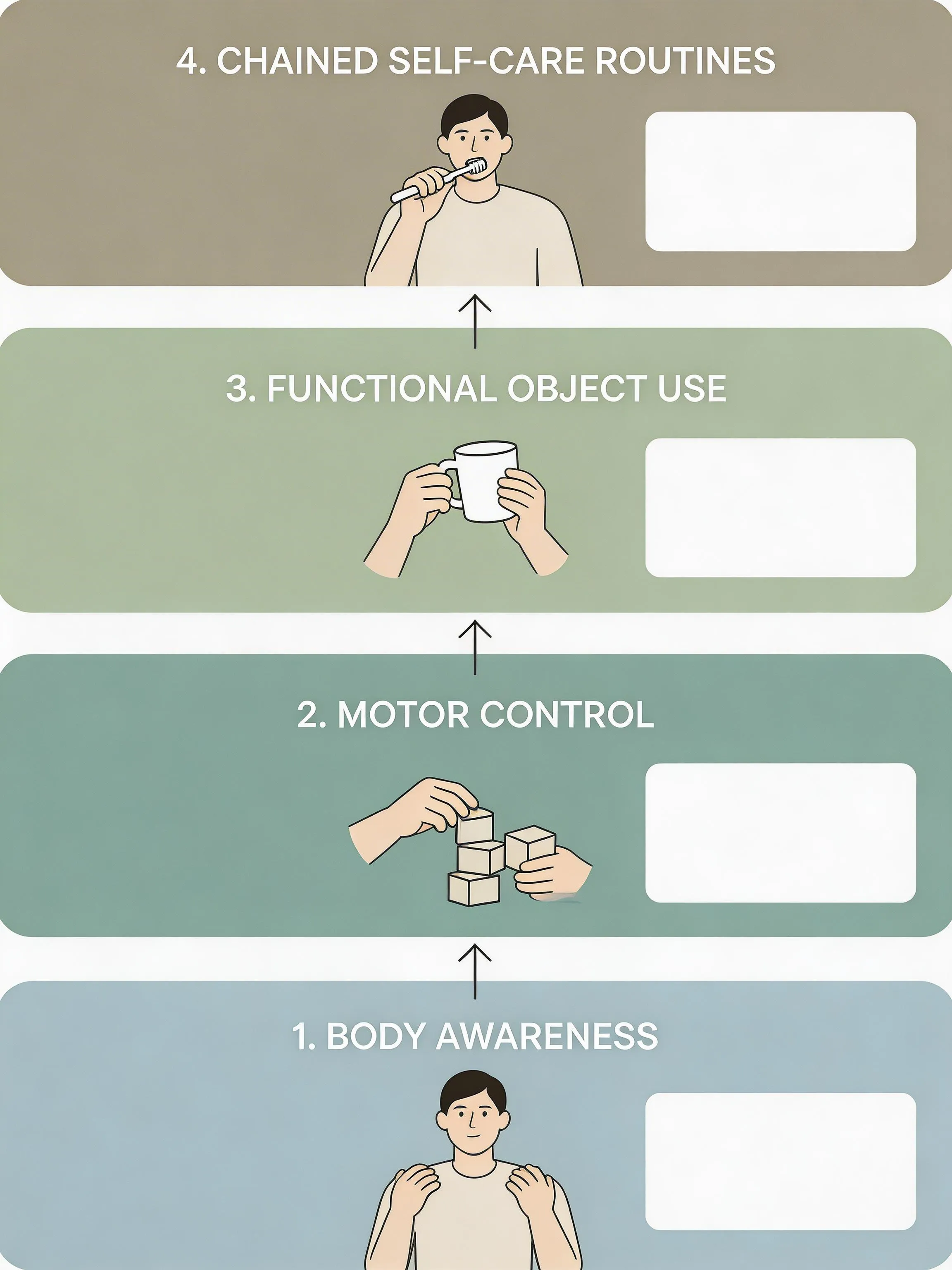
Independence is the most important long-term goal in autism support, and it is chronically undertaught. Programs focus on academic skills, communication milestones, and behavioral compliance while daily living skills — the skills that determine how much adult support a person will need for the rest of their life — receive scattered attention at best.
This guide covers how to think about independence as a teachable skill system, where to start, and how to build daily living skills that stick.
What independence actually looks like
Independence is not all-or-nothing. It is a continuum, and movement along that continuum happens in small steps.
For a young autistic child, independence might mean:
- Pulling off their shoes when asked (not waiting for an adult to do it)
- Carrying their plate to the counter after a meal
- Putting on a shirt after it has been positioned correctly
- Walking to the bathroom when they need to go (not being escorted)
For an older child, independence might mean:
- Getting dressed without reminders
- Making a simple breakfast
- Managing a morning routine with a visual checklist
- Recognizing when they need help and asking for it
The thread connecting all of these is the same: the child does something that an adult used to do for them. Every step toward independence is a step toward a life with more autonomy and less reliance on someone always being present.
Why independence is undertaught
There are three common patterns that lead to independence being neglected.
The compliance trap. Many programs prioritize compliance — the child does what the adult says. But compliance and independence are different things. A compliant child follows instructions. An independent child initiates actions without instructions. Programs focused on compliance can actually reduce independence by training children to wait for adult direction.
The efficiency instinct. It is faster to dress your child than to wait while they struggle with a shirt. It is easier to tie their shoes than to teach them to do it. Every day, well-meaning adults do things for children that the children could be learning to do themselves, because the short-term cost of teaching feels higher than the cost of just doing it. Over years, this compounds into deep dependence.
The prompt dependence barrier. Even when independence is targeted, poorly designed teaching can create prompt dependence — the child performs the skill only when prompted. The skill exists in the child’s repertoire, but it is locked behind an adult cue. For more on this, read Understanding Prompt Dependence in Autism.
Where to start
Identify the highest-impact daily routine
Look for a routine where you currently provide full support that happens every single day. Dressing, meals, bathroom routines, arrival and departure sequences — these are the best starting points because they are frequent, predictable, and directly affect daily life.
Break it into steps
Take the routine and list every step. For putting on a shirt:
- Pick up the shirt
- Orient it correctly (front/back, top/bottom)
- Put arms through sleeves
- Pull it over head
- Pull it down over torso
Use backward chaining
Start teaching from the last step, not the first. Do everything for the child except the final step, and let them complete that independently. Once the last step is mastered, you do everything except the last two steps. And so on.
Backward chaining works because the child always finishes the task successfully. Every repetition ends with independent completion, which builds confidence and momentum. Forward chaining (starting from step 1) often leads to frustration because the child gets stuck early and the adult has to take over, which reinforces dependence.
Fade your help systematically
At each step, track what kind of help you are providing:
- Full physical help (hand-over-hand)
- Partial physical help (a nudge or positioning)
- Gesture (pointing at the next step)
- Verbal cue (“Now pull it down”)
- Independent (no help needed)
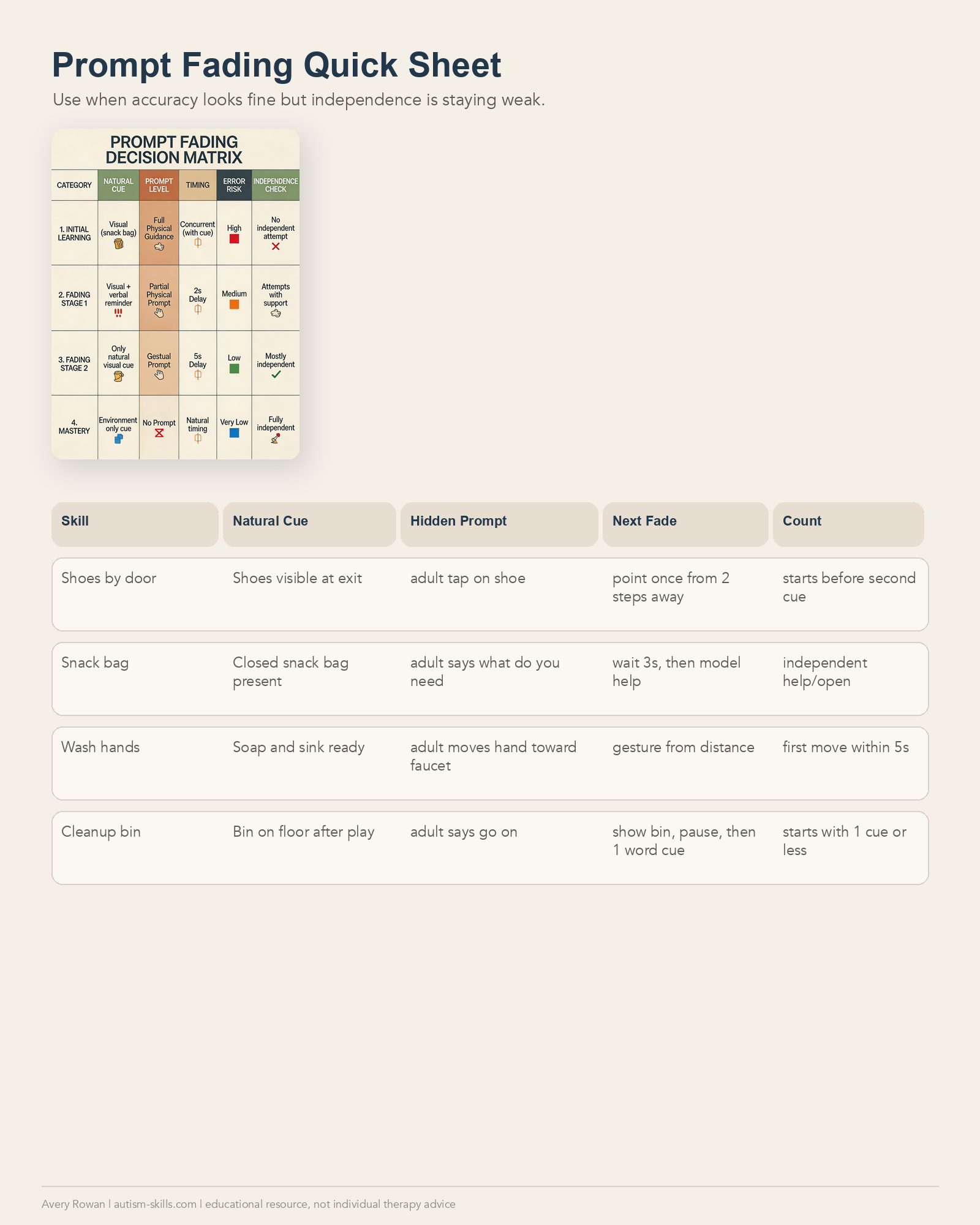
The goal is to move each step from full physical help toward independence. This does not happen overnight. It happens over weeks of consistent practice with intentional reduction of support.
Download the Prompt Fading Quick Sheet for worked examples of this fading process across everyday skills.
Building independence across daily life
Self-care routines
- Handwashing: Use a visual sequence posted at the sink. Fade from full physical help to the visual alone.
- Tooth brushing: Start by letting the child hold the brush and do the final stroke. Build toward the full routine.
- Toileting: Independence here is often the single highest-impact skill for school participation and community access.
- Dressing: Start with easy garments (pull-on pants, slip-on shoes) and build toward more complex items.
Household participation
Children learn independence through participation, not observation. Even small contributions build the expectation that the child is a participant in family life, not a passive recipient.
- Carrying items from one room to another
- Putting dirty clothes in a hamper
- Clearing their plate after meals
- Simple food preparation (pouring, spreading, stirring)
Choice-making
Independence requires decision-making, not just task completion. Build choice into daily life:
- Which shirt to wear
- Which snack to eat
- Which activity to do next
- When to ask for help
A child who can make choices and communicate them is significantly more independent than a child who performs tasks perfectly but only when directed.
How the handbook builds independence
Chapters 9 and 21 of the Autism Skills Handbook cover independence as a core design principle — not an afterthought. Chapter 9 addresses prompt dependence and how to design teaching that creates autonomous skill use. Chapter 21 covers home practice and daily routines, with the micro-routine model for embedding independence practice into ordinary life.
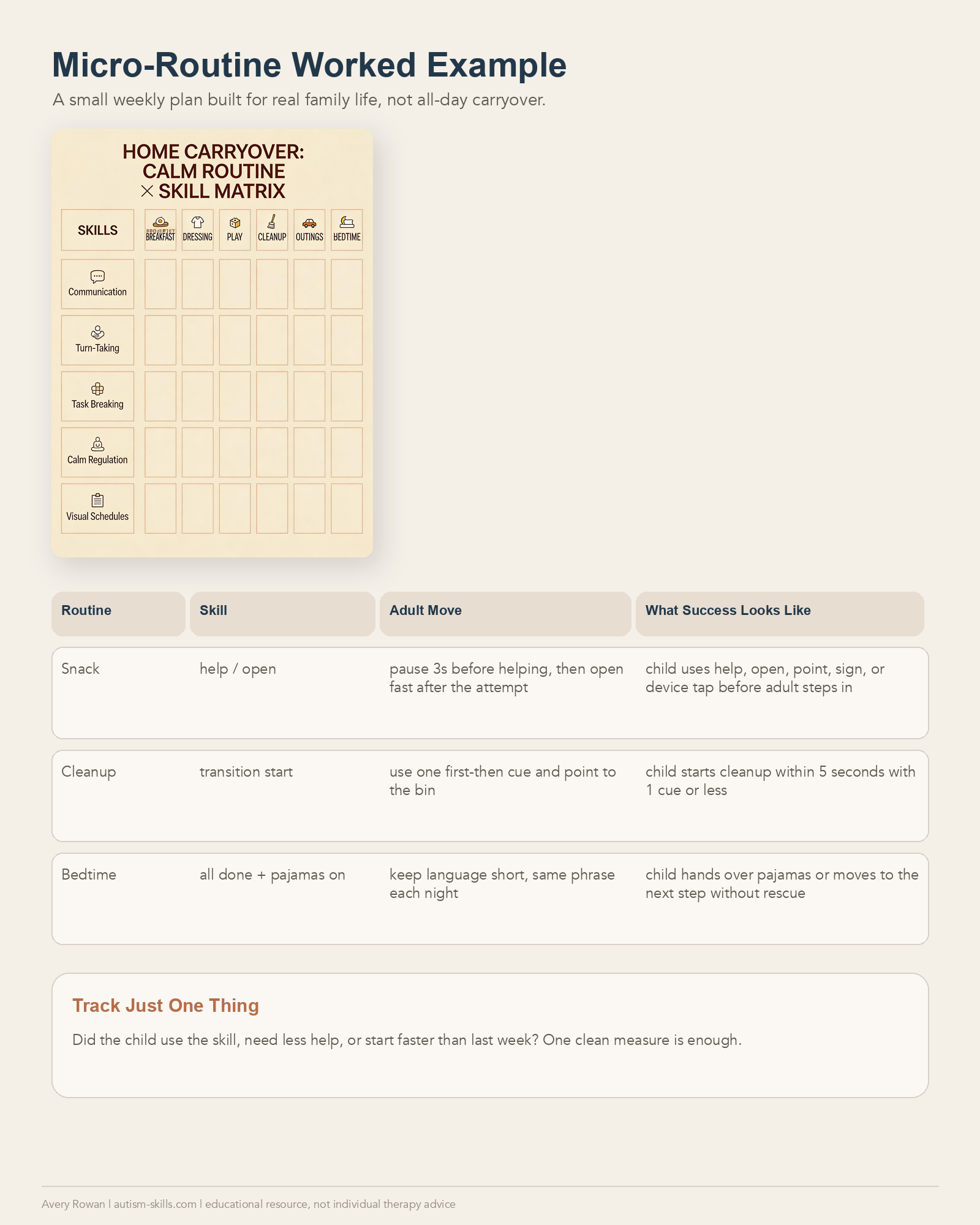
The Autism Daily Living Skills Checklist provides a practical way to record the current level of support across key routines and choose the next step. The Micro-Routine Worked Example shows how to attach independence practice to routines you already have.
Use the Autism Daily Living Skills Checklist to review communication, personal care, home routines, community safety, and self-advocacy without turning the list into an age-based pass/fail test.