
Flashcards are popular because they solve a real problem for adults. They make progress visible. A child who could not name ten animals last month and names twenty this month looks like a child who is learning.
The problem is not flashcards themselves. The problem is what happens when flashcard performance becomes the main measure of progress and the main use of teaching time.
Why flashcard teaching feels so productive
Flashcards have features that appeal to everyone tracking progress:
- they produce countable data
- correct answers are immediately visible
- adults can see improvement across sessions
- the format is easy to standardize across staff
- progress charts look clean
None of this is fake. The child really is performing better on the flashcard task. The question is whether that performance is changing anything outside the flashcard moment.
What often does not transfer
A child who can label fifty pictures at a table may still:
- not use those words to request, refuse, or comment in real life
- not recognize the same objects in different contexts
- not connect the label to function, category, or relevance
- lose the skill when the teaching format changes slightly
- need an adult to prompt every response
That gap between performance and function is where flashcard-heavy teaching often breaks down. The skill lives in one context, under one set of conditions, with one person asking in one particular way.
This is not generalization. This is performance trapped in a format.
The real cost
Every hour spent building non-functional flashcard skills is an hour not spent on something that might change daily life. Time is limited. Attention is limited. Motivation is limited.
When a child spends most of their teaching time naming pictures, matching, or sorting cards, the opportunity cost is often:
- functional communication that would reduce daily friction
- engagement and shared attention that would unlock broader learning
- independence skills that would relieve caregiver burden
- play that would build flexibility and social connection
The flashcard skill is real. But the question is whether it was the best possible use of that child’s learning time.
How to tell if this is happening
Ask these questions:
- Can the child use the same vocabulary in daily life without being asked?
- Does the child use the words to actually get something, refuse something, or tell someone something that matters?
- Would removing the card format change the child’s ability to show the skill?
- Are the targets on the flashcards the highest-leverage goals for this child right now?
- Is the team measuring transfer to real life, or only measuring session performance?
If most answers point back to the table and the card, the teaching is building a narrow skill, not a useful one.
What makes a goal high-leverage
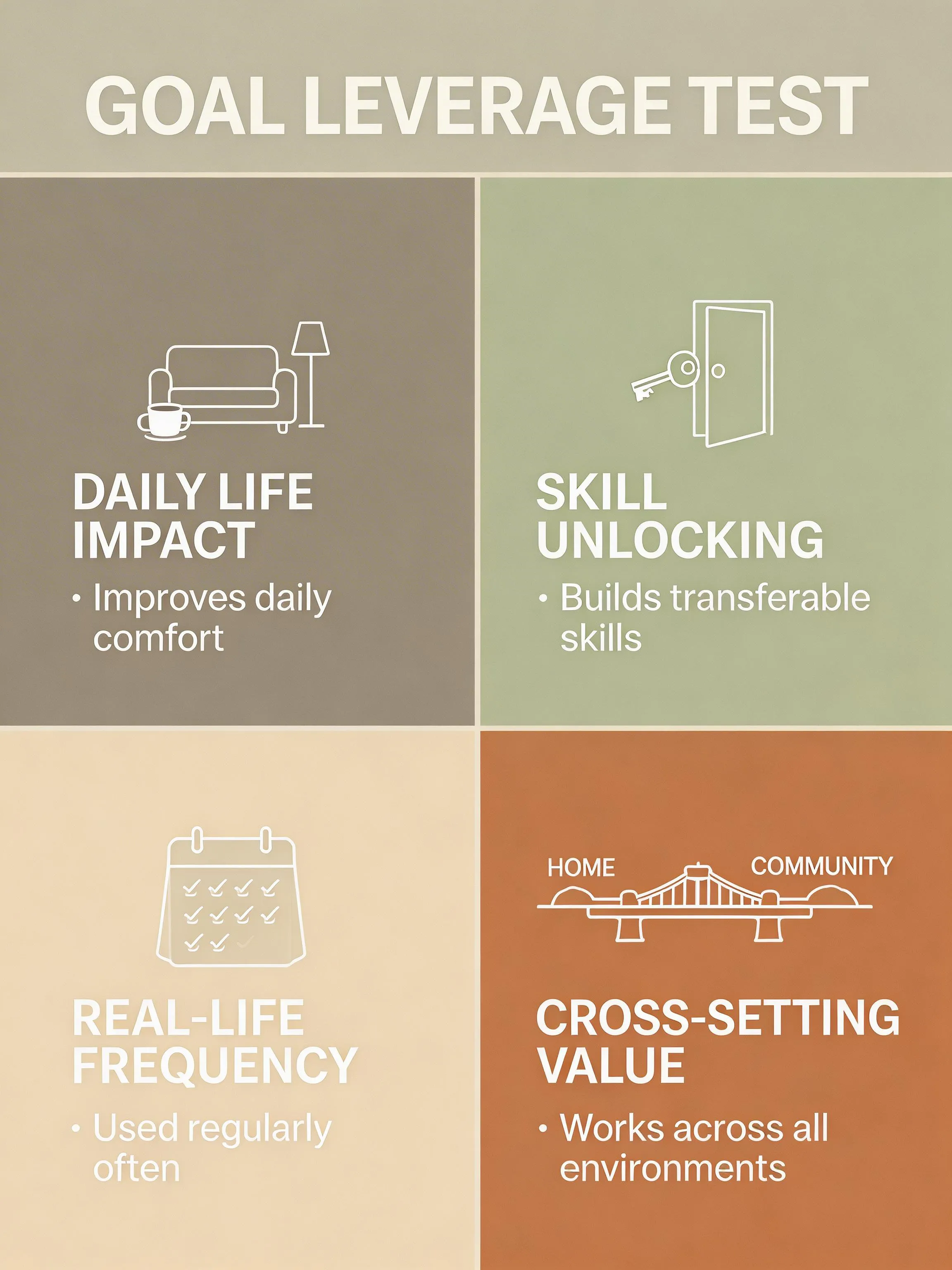
A high-leverage goal passes a simple test. Does it:
- make daily life easier?
- unlock other skills?
- get practiced often in real life?
- matter in more than one setting?
Naming fifty animals usually fails most of these. Asking for help, refusing clearly, following a short direction, or imitating a new action usually passes all of them.
The issue is not whether the flashcard skill is valid. It is whether it is the best use of the child’s time right now.
What to do instead
If your child’s program is flashcard-heavy, the goal is not to eliminate structured teaching. It is to make sure structured teaching targets the right skills and connects to real life.
Steps:
- Run the current targets through the leverage test. Which ones make daily life better? Which ones unlock other learning?
- Ask whether each target is being practiced in at least two settings. If it only works at the therapy table, it is probably too narrow.
- Shift some teaching time toward functional communication, engagement, and independence — skills that the child will use many times every day without an adult holding up a card.
- Ask the team how they plan to generalize what the child learns at the table into home, school, and community.
- Check whether the child’s strongest counting/naming skills are matched by equally strong functional skills. A large gap between performance skills and daily skills is a warning sign.
Flashcards are a tool, not a program
Flashcards can have a role. Quick review of known material. Building speed on a component skill. Checking retention. These are fine uses.
The problem starts when flashcard teaching becomes the center of the program because it produces the cleanest data and the most visible progress. When that happens, the adults are solving their own measurement problem, not the child’s developmental problem.
The child’s developmental problem is almost never “cannot name enough pictures.” It is usually closer to “cannot communicate what they need,” “cannot participate without constant adult rescue,” or “cannot show what they know in daily life.”
Those problems need different teaching. And they need goals chosen for leverage, not for visibility.
Read next
If you want a clearer framework for choosing goals that actually change daily life, read How to Choose Autism Goals That Matter.
If the child has many words but weak communication, read Functional Communication Before Complex Speech.
For the complete priority system, see the book.