
Most autism goal lists look impressive on paper. Communication targets. Language milestones. Behavior objectives. Social skills. Independence. The words sound right. The categories make sense.
But the test is not what the goal list looks like. The test is what an ordinary week looks like when the goals are working.
What working goals change
When a goal is high-leverage and the teaching is effective, daily life shifts in small but real ways:
- a morning routine that used to collapse three times now collapses once
- the child asks for help instead of throwing the thing they cannot open
- transitions that produced screaming now produce mild protest and then compliance
- an adult who used to guess what the child wanted now gets a clear signal
- a sibling who used to be ignored now gets a brief look and a shared moment
None of this is dramatic. All of it is real.
If the goals on the data sheet are being met but the week feels exactly the same, something is off. Either the goals are not the right ones, or the skills are not transferring.
Goals that look good but do not land
Some goals create impressive session footage without changing daily life. Common patterns:
Naming goals that never become communication. The child labels fifty pictures but does not use any of those words to request, refuse, or comment at home.
Compliance goals that never become independence. The child follows directions perfectly when prompted but never initiates anything without adult cueing.
Social goals that only work in the therapy room. The child takes turns with a therapist during a structured game but does not engage with peers in any unstructured moment.
Academic goals that skip foundations. The child recites the alphabet but cannot follow a two-step direction or participate in a group activity.
These are not fake goals. The skills are real. But they are not producing functional change in the child’s daily life.
What a strong goal sounds like
Strong goals tend to share certain features:
- They describe what the child will do, not what the adult will do. “Child will request help using a word or gesture before the adult steps in” is better than “staff will provide opportunities for requesting.”
- They matter across settings. If a goal only applies in one room with one person, it is too narrow. “Asks for help” should work at home, at school, and at the store.
- They have daily-life anchors. You should be able to name the specific moment in the week when this goal would make things better. Snack time. Getting dressed. Leaving the park. Arriving at school.
- They make the next skill possible. Asking for help makes participation easier. Tolerating small changes makes transitions smoother. Both of those open doors to further learning.
How to check your child’s current goals
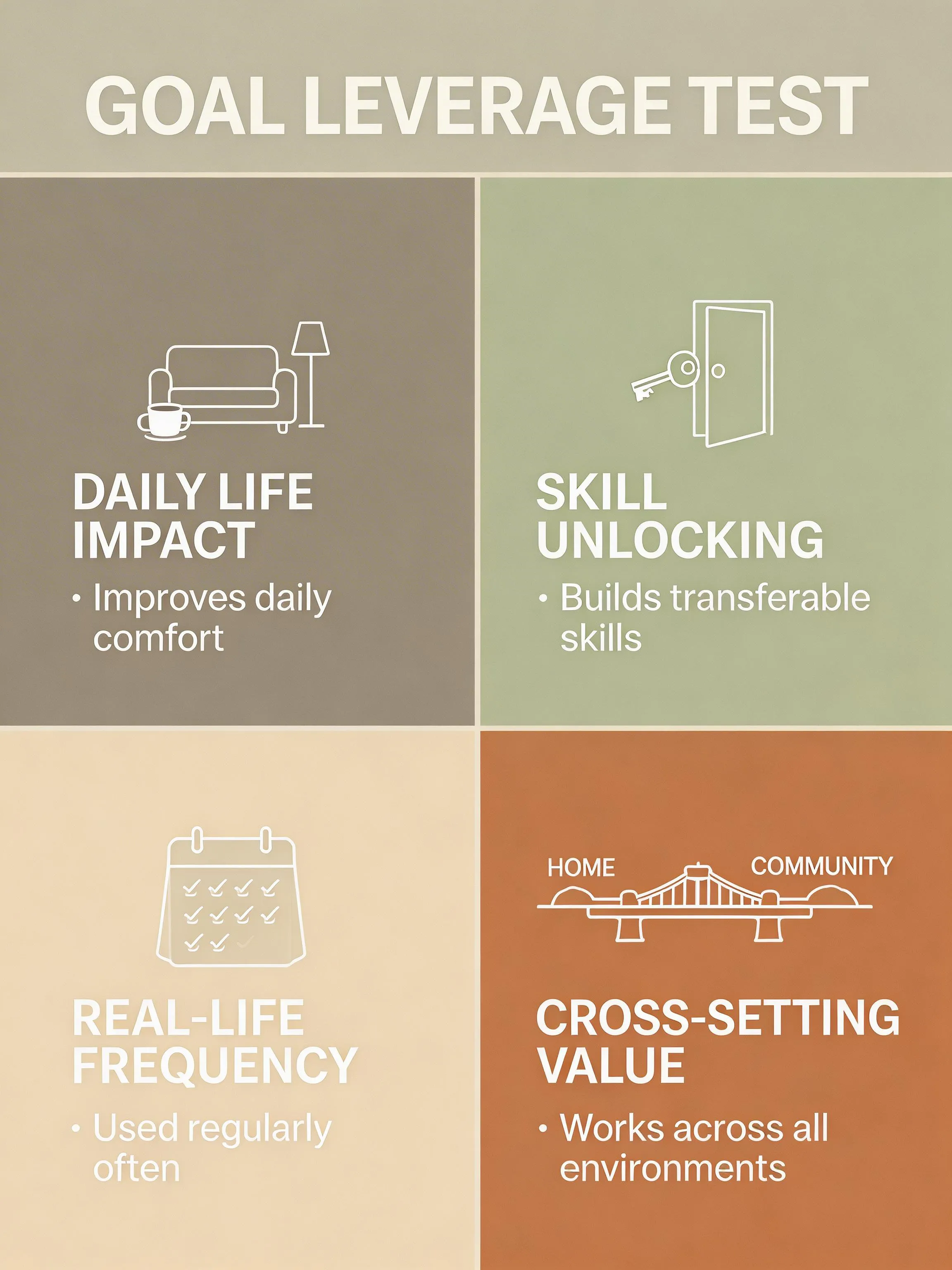
Take the current goal list and ask these questions for each one:
- Can I point to a specific daily moment where this would help?
- Is the child using this skill outside of sessions?
- Would this goal still matter if the child changed therapists, schools, or settings?
- Does this skill make other learning easier?
If a goal passes all four, it is probably high-leverage. If it passes none, it might be a low-priority target consuming high-priority time.
What parents can ask the team
When goals feel disconnected from real life, these questions can redirect the conversation:
- “What should I see at home if this goal is working?”
- “Which of these goals will make mornings easier?”
- “If we had to keep only three targets, which three would you pick?”
- “What skill is missing underneath the thing that is hardest for us right now?”
These are not adversarial questions. They are prioritization questions. Good teams welcome them because they make the plan sharper.
Fewer goals, better goals
A common instinct is to add goals when things are not improving. More targets. More hours. More data collection points.
Usually the opposite helps more. Fewer goals, chosen more carefully, practiced more consistently, reviewed more often.
A child working on three strong goals across all settings will usually outperform a child working on twelve disconnected goals that no one can track.
The weekly check
Once a week, ask yourself:
- What was the hardest moment this week?
- What skill was missing underneath it?
- Is any current goal directly addressing that missing skill?
If the hardest moments and the current goals are not connected, the plan might need a revision. Not more goals. Better goals.
Read next
If you want the full framework for selecting high-leverage goals, read How to Choose Autism Goals That Matter.
If you suspect the child’s program is building performance without function, read Why Flashcards Often Win Attention but Lose Real Progress.
If you want the full priority system, goal worksheets, and weekly review tools, see the book.